

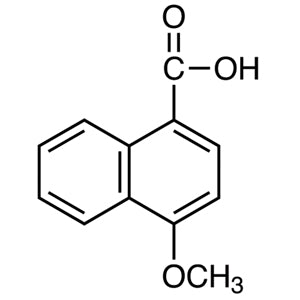
4-Methoxy-1-naphthoic Acid is a chemical compound widely used in laboratory settings for the synthesis of complex molecules. It serves as a fundamental building block in organic chemistry, enabling the creation of more intricate chemical structures. This compound is particularly valuable for its aromatic structure and the presence of a methoxy group, which contribute to its reactivity and stability under various conditions. Its versatility makes it a key component in multiple synthetic pathways, supporting research in both academic and industrial environments.
The compound's aromatic nature and reactive functional groups make it a preferred choice for a range of chemical reactions. Its ability to participate in substitution, esterification, and other reaction types enhances its utility in synthetic chemistry. The stability of 4-Methoxy-1-naphthoic Acid under controlled laboratory conditions ensures reliable results, making it a trusted material for chemists. Its availability in various packaging options further supports its widespread use in both small-scale and large-scale experiments.
In Indonesian laboratories, 4-Methoxy-1-naphthoic Acid is commonly used in organic synthesis and pharmaceutical research. Its role as a foundational compound allows researchers to develop new compounds with specific properties. The compound's accessibility and consistent quality make it a reliable choice for local scientists working on drug development and chemical innovation. Its presence in the local market facilitates its integration into routine laboratory practices, supporting ongoing scientific advancements.
Related TCI products
- Organic synthesis where aromatic compounds with methoxy groups are required for creating complex molecular structures.
- Esterification reactions due to its carboxylic acid functionality, enabling the formation of ester derivatives.
- Substitution reactions where the methoxy group can be replaced or modified to produce various functionalized products.
- Pharmaceutical research for the development of new drugs, as it can be a precursor to bioactive compounds.
- Chemical education and training, where it serves as a standard compound for teaching synthetic techniques and reaction mechanisms.
| Brand | TCI |
|---|---|
| CAS number | 13041-62-8 |
| Molecular formula | — |
| Purity | — |
| Category | Chemistry > Building Blocks > Non-Heterocyclic Building Blocks |
| Pack sizes | Available in various sizes to suit different laboratory needs |
| Physical form | Solid (crystalline or powder, depending on packaging) |
| Storage | Store in a cool, dry place away from direct sunlight |
4-Methoxy-1-naphthoic Acid should be stored in a cool, dry environment to maintain its chemical integrity. It is recommended to keep the compound in airtight containers to prevent moisture absorption and contamination. Due to its aromatic nature, it is advisable to store it away from strong odors or reactive substances to avoid unintended chemical interactions. Proper labeling of containers is essential for safe handling and identification. Laboratory personnel should wear appropriate personal protective equipment, such as gloves and safety goggles, when handling the compound. Regular inspection of storage conditions ensures the compound remains stable and suitable for use in experiments.
—
Produk Terkait
-
3-Methoxy-2-naphthoicAcid TCI M1461
Regular price From Rp 1.060.500,00Regular price -
6-Methoxy-2-naphthoicAcid TCI M1418
Regular price From Rp 2.862.300,00Regular price -
2-Methoxy-1-naphthoicAcid TCI M1417
Regular price Rp 1.908.900,00Regular price -
3-Hydroxy-7-methoxy-2-naphthoicAcid TCI H0707
Regular price Rp 1.881.600,00Regular price -
4-Bromo-1-naphthoicAcid TCI B4949
Regular price From Rp 769.650,00Regular price -
6-Bromo-2-naphthoicAcid TCI B3823
Regular price From Rp 1.431.150,00Regular price -
4-Bromo-3-hydroxy-2-naphthoicAcid TCI B3229
Regular price From Rp 2.174.550,00Regular price -
7-Bromo-3-hydroxy-2-naphthoicAcid TCI B3180
Regular price From Rp 769.650,00Regular price


