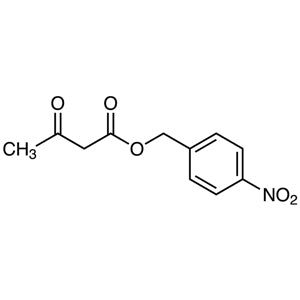
4-Nitrobenzyl Acetoacetate from TCI is a beta-keto ester. Its molecule combines an acetoacetate backbone with a 4-nitrobenzyl ester group, often abbreviated as PNB (p-nitrobenzyl). As a non-heterocyclic building block, it is widely used in organic synthesis that needs an acetoacetate unit with an ester protecting group that can be removed selectively. The literature describes it as an intermediate in synthetic routes to beta-lactam antibiotic frameworks, especially the carbapenem class. This gives it an important role in pharmaceutical synthetic chemistry.
Chemists choose this compound because it combines two useful features. First, the methylene group between the two carbonyls is acidic and reactive. It can be used for alkylation, Knoevenagel condensation, Hantzsch reactions, or diazo transfer reactions. Second, the p-nitrobenzyl ester is stable under many reaction conditions, yet it can be removed by catalytic hydrogenolysis or by reduction under relatively mild conditions. Mild deprotection matters for sensitive molecules such as the beta-lactam ring. The nitroaromatic group also helps with UV detection when monitoring reactions.
In Indonesia, this compound is used mainly in pharmaceutical chemistry laboratories, synthetic organic chemistry research groups, and university research facilities working on multistep synthesis. Researchers who build beta-lactam frameworks, study active methylene chemistry, or need a protected acetoacetate unit for later selective deprotection will find it a practical reagent. Because it is a TCI product, it gives consistent quality for both academic research and industrial process development.
- Carbapenem and beta-lactam synthesis: the compound is a known intermediate in routes to carbapenem antibiotic frameworks, where its mildly removable PNB ester protects the sensitive beta-lactam ring.
- Alkylation of active methylene: the acidic methylene group between the two carbonyls is easy to deprotonate, so it supports controlled C–C bond formation on the acetoacetate backbone.
- Knoevenagel condensation: its reactive methylene group condenses with aldehydes and ketones, giving unsaturated keto-ester products while the p-nitrobenzyl ester stays intact for later steps.
- Hantzsch reactions and diazo transfer: the beta-keto ester structure suits Hantzsch-type multicomponent reactions and diazo transfer, both of which are key steps in building complex synthetic intermediates.
- Protecting group strategy studies: the p-nitrobenzyl ester can be removed by catalytic hydrogenolysis or mild reduction, and its nitroaromatic group allows convenient UV monitoring of reaction progress.
| Brand | TCI (product code N0875) |
|---|---|
| CAS number | 61312-84-3 |
| Molecular formula | — |
| Purity | — |
| Category | Chemistry > Building Blocks > Non-Heterocyclic Building Blocks |
| Pack sizes | available pack sizes are listed on the product page |
| Physical form | — |
| Storage | follow the conditions on the TCI label and Safety Data Sheet |
- Chemical class: beta-keto ester with a 4-nitrobenzyl (PNB) ester group
Store 4-Nitrobenzyl Acetoacetate in its original tightly closed container, in a cool, dry, well-ventilated area away from direct sunlight, heat sources, and incompatible materials such as strong oxidizers, strong bases, and reducing agents. Always follow the storage conditions on the TCI label and Safety Data Sheet. Handle the compound in a fume hood and wear suitable personal protective equipment, including safety glasses, chemical-resistant gloves, and a lab coat. Avoid breathing dust or vapour and avoid contact with skin and eyes. Reseal the container right after use to prevent moisture uptake. Dispose of waste according to local regulations and your institution's chemical waste procedures.
—
Produk Terkait
-
4-NitrobenzylAcetate TCI A0039
Regular price From Rp 1.298.850,00Regular price -
Magnesium4-NitrobenzylMalonate TCI M0938
Regular price Rp 3.287.550,00Regular price -
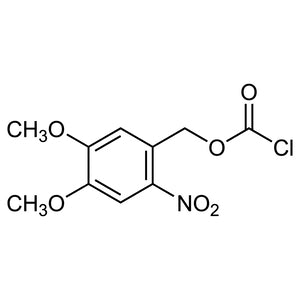
4,5-Dimethoxy-2-nitrobenzylCarbonochloridate TCI D6396
Regular price From Rp 1.378.650,00Regular price -
IsopropylAcetoacetate TCI I0826
Regular price From Rp 980.700,00Regular price -
LithiumAcetoacetate TCI A1478
Regular price From Rp 3.180.450,00Regular price -
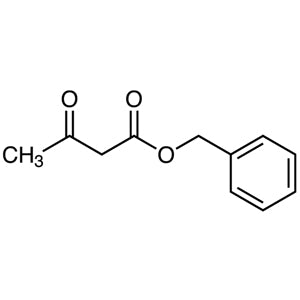
BenzylAcetoacetate TCI A1080
Regular price From Rp 1.167.600,00Regular price -
n-OctylAcetoacetate TCI A0915
Regular price Rp 3.367.350,00Regular price -
HexylAcetoacetate TCI A0913
Regular price Rp 2.041.200,00Regular price