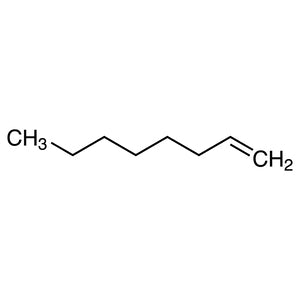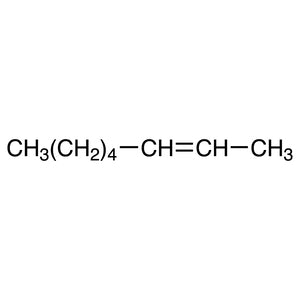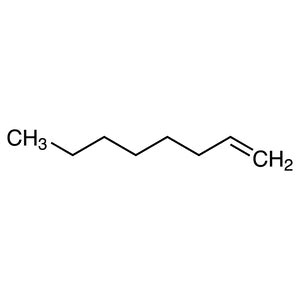
1-Octene is a straight-chain alkene with eight carbon atoms and a double bond at the end of the chain. It belongs to the class of linear alpha-olefins. TCI supplies it as a non-heterocyclic building block for organic synthesis and materials research. In industry, 1-octene is known as a comonomer in the production of certain polyethylenes. In the laboratory, it is one of the most common model substrates for terminal alkene reactions, including hydroformylation, epoxidation, hydroboration, metathesis, and hydrosilylation.
Researchers choose 1-Octene because its terminal double bond is reactive and easy to reach sterically, while the rest of the molecule is a saturated chain that does not interfere with the reaction. This lets researchers judge how well a new catalyst or reagent performs, including how selective it is for linear products over branched ones. The compound is nonpolar, dissolves easily in organic solvents, and is easy to analyse by gas chromatography, so conversions and product ratios are simple to measure. Because it is volatile and flammable, it needs the standard precautions used for hydrocarbon liquids.
In Indonesia, 1-Octene is relevant to university research groups working on homogeneous and heterogeneous catalysis. Polymer laboratories studying olefin-based materials use it, and so do organic synthesis groups that need a reliable terminal alkene substrate. It suits method development, catalyst screening, and teaching experiments that show classic alkene chemistry. Research institutes and industrial R&D laboratories can also use it as a well-defined reference olefin when comparing reaction conditions, because its simple structure gives results that are easy to interpret.
- Hydroformylation studies: the unhindered terminal double bond makes 1-Octene a standard substrate for measuring catalyst activity and the ratio of linear to branched aldehyde products.
- Epoxidation reactions: its reactive terminal alkene and inert saturated chain let researchers test new oxidants or catalysts without side reactions from other functional groups.
- Hydroboration and hydrosilylation: 1-Octene is widely used to test regioselectivity, because adding reagents across its accessible terminal double bond clearly shows whether terminal or internal products are favoured.
- Olefin metathesis research: as a simple linear alpha-olefin, it is a convenient model substrate for testing metathesis catalysts and following product formation by gas chromatography.
- Polymer and comonomer research: because 1-octene is a known comonomer in certain polyethylenes, it is useful in laboratory studies of olefin copolymerisation and of how polymer materials are built.
| Brand | TCI (product code O0041) |
|---|---|
| CAS number | 111-66-0 |
| Molecular formula | — |
| Purity | — |
| Category | Chemistry > Building Blocks > Non-Heterocyclic Building Blocks |
| Pack sizes | available in TCI's standard pack sizes; see the product listing for current options |
| Physical form | volatile, flammable hydrocarbon liquid |
| Storage | keep tightly closed in a cool, well-ventilated area away from ignition sources |
Store 1-Octene in its original, tightly sealed container in a cool, dry, well-ventilated area designated for flammable liquids. Keep it away from heat, sparks, open flames, and strong oxidising agents. Because the compound is volatile, close containers promptly after use to limit vapour loss and build-up. Handle it in a fume hood and wear standard personal protective equipment, including safety glasses, chemical-resistant gloves, and a laboratory coat. Ground equipment where needed to prevent static discharge, keep suitable fire-extinguishing equipment nearby, and follow the Safety Data Sheet and your institution's chemical safety procedures when handling, transferring, and disposing of the material.
—
Produk Terkait
-
1-Octene TCI O0251
Regular price Rp 2.518.950,00Regular price -
trans-4-Octene TCI O0136
Regular price From Rp 848.400,00Regular price -
cis-4-Octene TCI O0135
Regular price From Rp 689.850,00Regular price -
trans-3-Octene TCI O0134
Regular price From Rp 1.220.100,00Regular price -
cis-3-Octene TCI O0133
Regular price Rp 12.614.700,00Regular price -
trans-2-Octene TCI O0132
Regular price From Rp 1.936.200,00Regular price -
2-Octene(cis-andtrans-mixture) TCI O0042
Regular price From Rp 1.220.100,00Regular price -
8-Bromo-1-octene TCI B3257
Regular price From Rp 3.525.900,00Regular price