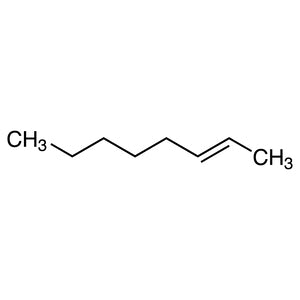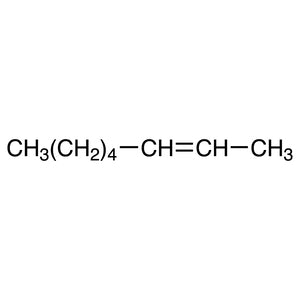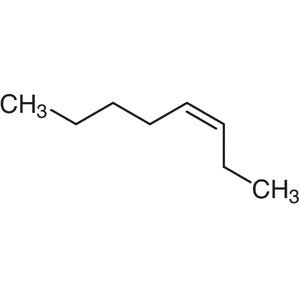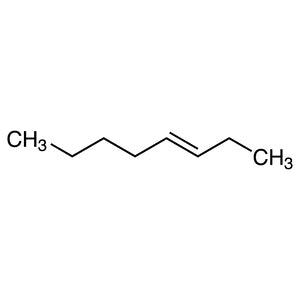
trans-3-Octene from TCI, product code O0134, is the trans (E) geometric isomer of 3-octene. It is a straight-chain, eight-carbon alkene with its double bond at the third carbon. In the laboratory it is classed as a versatile non-heterocyclic building block. Researchers use it as a substrate for double-bond transformations and as a reference compound in studies of internal olefin reactivity. It is almost always paired with cis-3-Octene when researchers want to separate the effect of molecular geometry from other reaction variables.
Several properties make this compound a common choice. The trans configuration is generally more thermodynamically stable than the cis isomer. Its spatial arrangement is also different, so the molecule approaches a catalyst surface or a reagent in a different way. Researchers use this difference in studies of selectivity, kinetics, and reaction mechanism. Because the molecule has no other functional groups, all of its reactivity is centred on the double bond, which makes experimental results easier to interpret. It also works well as a standard for confirming product identity in isomerization or elimination reactions that give mixtures of alkenes.
In Indonesia, trans-3-Octene is typically used in university organic chemistry laboratories, catalysis research groups, and industrial research and development facilities. Graduate students and researchers use it in hydrogenation, oxidation, and isomerization experiments, and for comparative studies of cis and trans alkenes. Analytical laboratories use it as a reference substance when identifying alkene products by chromatography. As a TCI product, it gives Indonesian laboratories a consistent, well-documented material for teaching, method development, and published research.
- Double-bond transformation studies: the single internal double bond makes this compound a clean substrate for hydrogenation, epoxidation, hydroformylation, and other alkene reactions.
- Geometric isomer comparison: used with cis-3-Octene, it lets researchers isolate the effect of trans versus cis geometry on reaction rate, selectivity, and product distribution.
- Catalyst selectivity and mechanism research: the way the trans isomer approaches a catalyst surface differs from the cis form, which helps researchers probe how catalysts discriminate between alkenes.
- Reference standard for alkene mixtures: it helps confirm product identity in isomerization or elimination reactions that give several octene isomers, supporting reliable chromatographic assignment.
- Model compound for internal olefin reactivity: with no other functional groups, it gives researchers a simple, interpretable system for studying how internal alkenes behave under different reaction conditions.
| Brand | TCI (product code O0134) |
|---|---|
| CAS number | 14919-01-8 |
| Molecular formula | — |
| Purity | — |
| Category | Chemistry > Building Blocks > Non-Heterocyclic Building Blocks |
| Pack sizes | as listed on the product page |
| Physical form | liquid at room temperature |
| Storage | keep tightly closed in a cool, well-ventilated place away from heat and ignition sources |
Store trans-3-Octene in its original, tightly sealed container in a cool, dry, well-ventilated area away from heat, sparks, open flames, and strong oxidizing agents. Like other low-molecular-weight hydrocarbons, it should be treated as a flammable liquid. Use it in a fume hood, with nitrile gloves, safety glasses, and a laboratory coat. Keep containers closed when not in use to limit evaporation and exposure to air. Ground equipment when transferring larger volumes. Follow the Safety Data Sheet supplied with the product for specific hazard, first-aid, and disposal guidance, and dispose of waste according to local regulations.
—
Produk Terkait
-
trans-4-Octene TCI O0136
Regular price From Rp 848.400,00Regular price -
trans-2-Octene TCI O0132
Regular price From Rp 1.936.200,00Regular price -
2-Octene(cis-andtrans-mixture) TCI O0042
Regular price From Rp 1.220.100,00Regular price -
1-Octene TCI O0251
Regular price Rp 2.518.950,00Regular price -
cis-4-Octene TCI O0135
Regular price From Rp 689.850,00Regular price -
cis-3-Octene TCI O0133
Regular price Rp 12.614.700,00Regular price -
1-Octene TCI O0041
Regular price From Rp 477.750,00Regular price -
1,3-Pentadiene(cis-andtrans-mixture)(stabilizedwithTBC) TCI P1841
Regular price Rp 10.229.100,00Regular price