

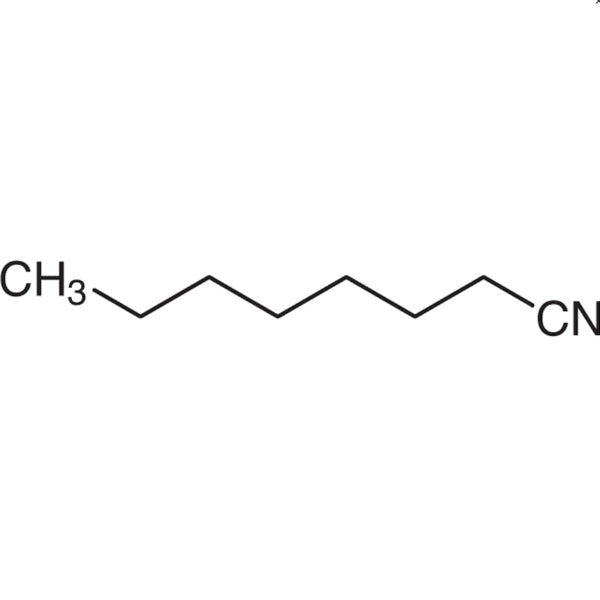
Octanenitrile from TCI, also known as heptyl cyanide or caprylonitrile, is an eight-carbon aliphatic nitrile supplied as a liquid. It is classed as a non-heterocyclic building block and is especially useful because its nitrile group can be converted into many other functional groups. In the laboratory, octanenitrile is a starting material for primary amines by reduction, for carboxylic acids or amides by hydrolysis, and for ketones by reaction with organometallic reagents. One material therefore opens several synthetic routes to eight-carbon compounds.
Researchers choose octanenitrile because its nitrile group stays reasonably stable in storage but still reacts readily under the right conditions. The straight alkyl chain gives the molecule moderate lipophilicity, so its derivatives are generally easy to extract and purify. Because it is a liquid, it is convenient to measure by volume for both small-scale and medium-scale reactions. Octanenitrile can also serve as a model compound in catalysis studies, such as the hydrogenation of nitriles to amines. Its structure is simple, and the reaction products are easy to analyse by gas chromatography.
In Indonesian laboratories, octanenitrile is mainly used in university organic chemistry research groups, in synthesis laboratories that develop intermediates, and in catalysis research teams that need a reliable nitrile substrate. It works well in teaching and research settings where students and scientists study functional group transformations step by step. Its role as a model substrate also suits groups that compare catalyst performance. Here it can be used as a consistent reference material across repeated experiments and between different research projects.
- Synthesis of primary amines: the nitrile group of octanenitrile can be reduced to an eight-carbon primary amine, making it a direct and practical precursor for amine-based intermediates.
- Preparation of carboxylic acids and amides: hydrolysis of the nitrile group turns octanenitrile into the matching eight-carbon acid or amide, giving access to useful derivatives from one starting material.
- Ketone synthesis with organometallic reagents: octanenitrile reacts with organometallic reagents to form ketones, letting chemists build carbon–carbon bonds and extend the molecular framework in a controlled way.
- Model substrate for catalysis studies: its simple structure makes octanenitrile well suited to studying nitrile hydrogenation to amines, since the products are easy to analyse by gas chromatography.
- Teaching and research on functional group transformations: because one nitrile can be converted into amines, acids, amides, and ketones, it is a clear example compound for showing functional group interconversion in organic synthesis.
| Brand | TCI (product code O0221) |
|---|---|
| CAS number | 124-12-9 |
| Molecular formula | — |
| Purity | — |
| Category | Chemistry > Building Blocks > Non-Heterocyclic Building Blocks |
| Pack sizes | please check the product page for the pack sizes currently offered |
| Physical form | liquid |
| Storage | keep tightly closed in a cool, dry, well-ventilated place; follow the manufacturer's label and Safety Data Sheet |
Store octanenitrile in its original, tightly sealed container, or in a compatible chemically resistant glass container. Keep it in a cool, dry, well-ventilated area away from heat, ignition sources, strong acids, strong oxidising agents, and direct sunlight. Handle it in a fume hood and wear suitable personal protective equipment, including chemical-resistant gloves, safety glasses, and a laboratory coat. Do not inhale vapours and avoid contact with skin and eyes. Label containers clearly, dispose of waste according to local regulations, and always check the Safety Data Sheet supplied with the product before use.
—
Produk Terkait
-
2-Phenylbutanenitrile TCI P1664
Regular price From Rp 1.087.800,00Regular price -
Heptanenitrile TCI H0883
Regular price Rp 4.479.300,00Regular price -
Undecanenitrile TCI U0044
Regular price Rp 3.710.700,00Regular price -
3-Oxo-3-(p-tolyl)propanenitrile TCI T3700
Regular price Rp 1.273.650,00Regular price -
6-Aminohexanenitrile TCI A3525
Regular price Rp 4.001.550,00Regular price -
Tridecanenitrile TCI T0819
Regular price Rp 2.016.000,00Regular price -
Nonanenitrile TCI P0020
Regular price Rp 1.749.300,00Regular price -
Nonadecanenitrile TCI N0458
Regular price Rp 2.147.250,00Regular price


