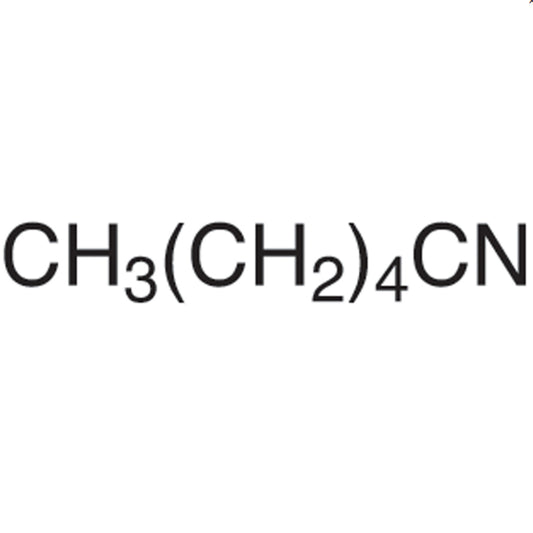
Heptanenitrile (TCI H0883), with CAS number 629-08-3, is a chemical compound classified under the category of non-heterocyclic building blocks in chemistry. It serves as a fundamental reagent in organic synthesis, providing a versatile platform for the creation of more complex molecular structures. This compound is widely used in laboratory settings due to its ability to participate in various chemical reactions, making it an essential tool for researchers working in synthetic chemistry. Its role is critical in the development of pharmaceutical compounds and industrial chemicals, where precise molecular manipulation is required.
Heptanenitrile is a preferred choice in laboratory applications due to its chemical stability under controlled conditions and its reactivity in substitution and addition reactions. It is a colorless liquid, which makes it easy to handle and integrate into different reaction systems. Its molecular structure, featuring a nitrile group at the end of a seven-carbon chain, allows for a wide range of chemical transformations. This combination of stability and reactivity makes it a reliable and efficient building block for chemists seeking to synthesize new compounds with specific functional groups.
In Indonesian laboratories, heptanenitrile is commonly used in organic chemistry research, particularly in pharmaceutical and industrial chemical development. Its availability, chemical properties, and reactivity make it a popular choice among researchers. It is often employed in the synthesis of complex organic molecules, contributing to advancements in drug discovery and chemical manufacturing. Its role in supporting scientific innovation underscores its importance in the chemical research landscape in Indonesia.
- Organic synthesis is a key application where heptanenitrile is used to build complex molecular structures through various chemical reactions.
- Pharmaceutical research benefits from heptanenitrile as it can be modified to create compounds with therapeutic properties.
- Industrial chemical production utilizes heptanenitrile for the synthesis of functionalized compounds used in manufacturing processes.
- Analytical chemistry laboratories use heptanenitrile as a reference standard for testing and calibration of analytical instruments.
- Research and development in chemical engineering rely on heptanenitrile for the creation of new materials and chemical intermediates.
| Brand | TCI |
|---|---|
| CAS number | 629-08-3 |
| Molecular formula | — |
| Purity | — |
| Category | Chemistry > Building Blocks > Non-Heterocyclic Building Blocks |
| Pack sizes | Available in various quantities as per supplier specifications |
| Physical form | Colorless liquid |
| Storage | Store in a cool, dry place away from direct sunlight and incompatible substances |
Heptanenitrile should be stored in a cool, dry environment, away from direct sunlight and sources of heat. It is recommended to keep it in a sealed container to prevent evaporation and contamination. Due to its reactivity, it should be stored separately from strong bases, reducing agents, and other incompatible chemicals. In laboratory settings, it is important to use appropriate personal protective equipment, such as gloves and safety goggles, when handling this compound. Proper ventilation should be maintained to minimize exposure to vapors. Regular monitoring of storage conditions ensures the compound remains stable and safe for use in chemical experiments.
—
Produk Terkait
-
Octanenitrile TCI O0221
Regular price From Rp 1.829.100,00Regular price -
2-Phenylbutanenitrile TCI P1664
Regular price From Rp 1.087.800,00Regular price -
Nonanenitrile TCI P0020
Regular price Rp 1.749.300,00Regular price -
Hexanenitrile TCI H0102
Regular price From Rp 1.167.600,00Regular price -
Decanenitrile TCI D2426
Regular price From Rp 1.140.300,00Regular price -
Undecanenitrile TCI U0044
Regular price Rp 3.710.700,00Regular price -
3-Oxo-3-(p-tolyl)propanenitrile TCI T3700
Regular price Rp 1.273.650,00Regular price -
6-Aminohexanenitrile TCI A3525
Regular price Rp 4.001.550,00Regular price