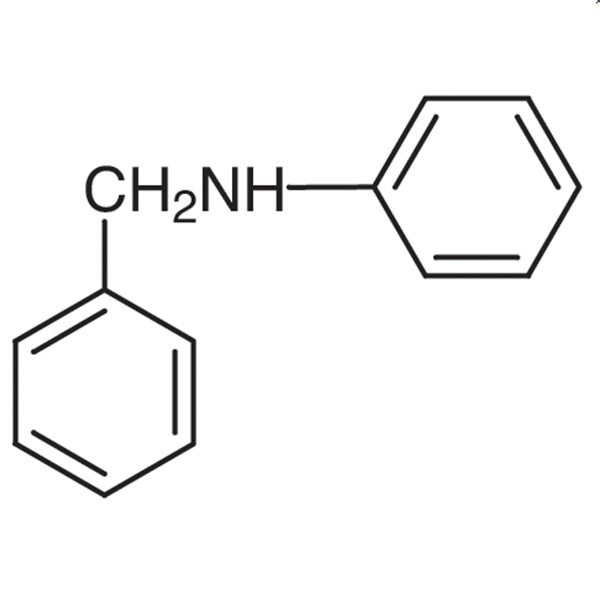
N-Phenylbenzylamine from TCI, also known as N-benzylaniline, is an aromatic secondary amine whose nitrogen atom carries one phenyl group and one benzyl group. As a non-heterocyclic building block, it is a versatile starting material in organic synthesis. It is mainly used to build tertiary amines, amides and a wide range of nitrogen-containing compounds needed in pharmaceutical, agrochemical and dye research. The structure is simple, but it offers a nucleophilic centre and two aromatic rings that react differently, so chemists can use it in many synthetic routes.
Chemists choose this compound because its secondary nitrogen is still nucleophilic. It can be alkylated, acylated or sulfonylated, and it can take part in C–N coupling reactions. Having a phenyl group bonded directly to the nitrogen alongside a benzyl group gives it distinctive behaviour. The anilinic nitrogen is less basic than an aliphatic amine, and the N-benzyl group can be removed by catalytic hydrogenolysis under suitable conditions. This makes the compound a useful intermediate when the benzyl group serves as a temporary protecting group during a multistep synthesis.
In Indonesia, N-Phenylbenzylamine suits synthetic organic chemistry, medicinal chemistry and catalysis laboratories at universities, research institutes and industrial R&D facilities. Researchers can use it to develop new synthetic methods, prepare reference intermediates or teach the reactivity of secondary aromatic amines in advanced coursework. Because it comes from TCI, laboratories get a well-characterised building block for routine and exploratory work. This supports reproducible results across projects in academic and industrial chemistry settings.
Related TCI products
- Synthesis of tertiary amines: the nucleophilic secondary nitrogen can be alkylated to build substituted tertiary amines, which are common scaffolds in pharmaceutical and fine chemical research.
- Amide and sulfonamide preparation: acylation or sulfonylation of the nitrogen gives N,N-disubstituted amides and sulfonamides, which medicinal chemists need for structure–activity studies.
- C–N cross-coupling studies: the secondary amine can serve as a coupling partner in C–N bond-forming reactions, so it is useful for testing and optimising catalytic systems in catalysis laboratories.
- Benzyl protecting group strategies: the N-benzyl group can be removed by catalytic hydrogenolysis under suitable conditions, so the compound works as an intermediate where temporary protection of the nitrogen is required.
- Dye and agrochemical intermediate research: its two aromatic rings and reactive nitrogen centre make it a practical starting point for building nitrogen-containing compounds explored in dye and agrochemical development.
| Brand | TCI |
|---|---|
| CAS number | 103-32-2 |
| Molecular formula | — |
| Purity | — |
| Category | Chemistry > Building Blocks > Non-Heterocyclic Building Blocks |
| Pack sizes | see the pack size options shown for product code P0159 |
| Physical form | see the TCI product specification or certificate of analysis |
| Storage | keep tightly closed in a cool, dry, well-ventilated place, as stated on the TCI label |
Store N-Phenylbenzylamine in its original, tightly closed TCI container. Keep it in a cool, dry, well-ventilated area away from direct sunlight, heat sources, strong oxidising agents and acids. Label the container clearly and keep it with compatible organic reagents. Handle the compound in a fume hood and wear suitable personal protective equipment, including chemical-resistant gloves, safety glasses and a lab coat. Avoid breathing in vapour or dust and avoid contact with skin and eyes. Read the TCI Safety Data Sheet before use for hazard information, first aid measures and disposal requirements. Dispose of waste according to local regulations and institutional laboratory procedures.
—
Produk Terkait
-
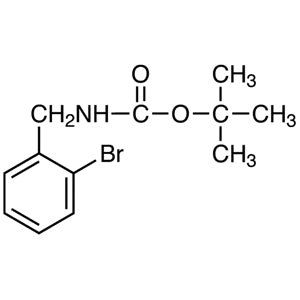
2-Bromo-N-(tert-butoxycarbonyl)benzylamine TCI B4920
Regular price From Rp 1.035.300,00Regular price -
3-Amino-N-methylbenzylamine TCI A2158
Regular price From Rp 875.700,00Regular price -
2,4,6-TrimethylbenzylCyanide TCI T1938
Regular price Rp 1.298.850,00Regular price -
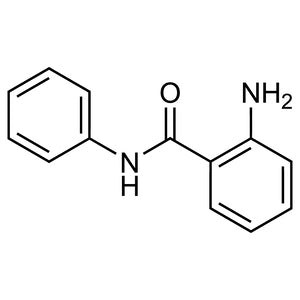
2-Amino-N-phenylbenzamide TCI A3723
Regular price From Rp 2.518.950,00Regular price -
4-Aminobenzylamine TCI A1436
Regular price From Rp 4.479.300,00Regular price -
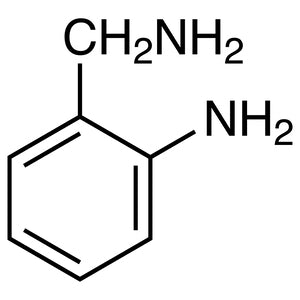
2-Aminobenzylamine TCI A1435
Regular price Rp 3.207.750,00Regular price -
3-Aminobenzylamine TCI A1431
Regular price From Rp 848.400,00Regular price -
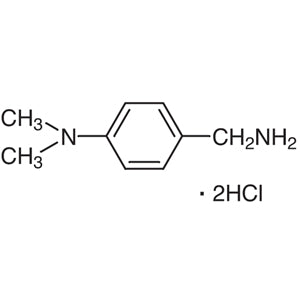
4-DimethylaminobenzylamineDihydrochloride TCI D1620
Regular price From Rp 3.763.200,00Regular price