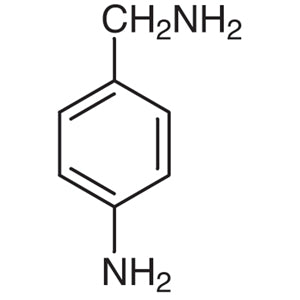
4-Aminobenzylamine (4-ABZ) is a chemical compound widely used in various laboratory reactions. As a fundamental building block, it plays a crucial role in the synthesis of complex molecules, particularly in organic and pharmaceutical research. Its active amine group allows it to act as an electron donor or participate in substitution reactions, making it a versatile reagent in chemical synthesis. This compound is essential in the development of pharmaceuticals, industrial chemicals, and advanced materials. Its chemical stability under certain conditions, combined with its reactivity towards acids, bases, and organic reagents, makes it a valuable tool in synthetic chemistry.
The active amine group of 4-Aminobenzylamine enables it to readily react with various ligands or substrates in chemical reactions. This reactivity is key to its application in the synthesis of heterocyclic compounds and other complex structures. Its ability to form stable intermediates and participate in multiple reaction pathways makes it a preferred choice for chemists working on drug development and molecular modification. The compound’s structural simplicity and functional versatility contribute to its widespread use in both academic and industrial research settings.
In Indonesian laboratories, 4-Aminobenzylamine is commonly used in organic chemistry, pharmaceutical, and materials research. It is frequently found in labs focused on drug development, molecular modification, and the study of chemical reactivity. Due to its availability and chemical properties, it remains a key reagent in the synthesis of new compounds and the exploration of chemical reactions. Its role in advancing scientific research in Indonesia underscores its importance in the chemical industry and academic institutions.
TCI brochures (PDF)
- Raw Materials for Polyimide Synthesis 2026-05-11 · p. 4
- Biomaterials Research Reagents 2025-02-19 · p. 17
- Monomers 2025-05-28 · p. 29
- Organic synthesis applications benefit from 4-Aminobenzylamine due to its active amine group, which facilitates the formation of complex molecular structures through various reaction mechanisms.
- Pharmaceutical research utilizes this compound for the development of new drugs, as it can serve as a building block in the synthesis of bioactive molecules and drug candidates.
- Materials science applications rely on 4-Aminobenzylamine for the creation of advanced materials, where its chemical reactivity supports the formation of functional polymers and composite structures.
- Chemical modification projects often incorporate this reagent to alter molecular properties, enabling the design of compounds with enhanced reactivity or specific functional groups.
- Research on chemical reactivity and reaction mechanisms benefits from the compound’s ability to participate in diverse chemical transformations, providing insights into reaction pathways and intermediates.
| Brand | TCI |
|---|---|
| CAS number | 4403-71-8 |
| Molecular formula | — |
| Purity | — |
| Category | Chemistry > Building Blocks > Non-Heterocyclic Building Blocks |
| Pack sizes | Available in various quantities as per supplier specifications |
| Physical form | Liquid or solid, depending on the specific product formulation |
| Storage | Store in a cool, dry place away from direct sunlight and incompatible materials |
4-Aminobenzylamine should be stored in a cool, dry place, away from direct sunlight and sources of heat. It is recommended to use airtight containers made of materials compatible with its chemical properties, such as glass or high-density polyethylene. Due to its reactivity, it should be kept away from strong acids, bases, and oxidizing agents. Proper labeling and storage in a designated chemical storage area are essential for safety. Laboratory personnel should wear appropriate personal protective equipment, including gloves and safety goggles, when handling this compound. Regular monitoring of storage conditions ensures the compound remains stable and safe for use in chemical experiments.
—
Product Categories
- Polymer/Macromolecule ReagentsMonomersDiamine Monomers
- Polymer/Macromolecule ReagentsPolyimide Raw MaterialsDiamines [Polyimide Raw Materials]
- Biomaterials/Biocompatible Materials Research ReagentsMonomers and Macromonomers [Biomaterials/Biocompatible Materials Research Reagents]Diamine Monomers [Biomaterials/Biocompatible Materials Research Reagents]
Produk Terkait
-
3-Aminobenzylamine TCI A1431
Regular price From Rp 900.900,00Regular priceRp 645.750,00Sale price From Rp 900.900,00 -
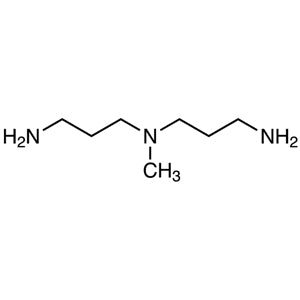
3,3'-Diamino-N-methyldipropylamine TCI B0821
Regular price From Rp 477.750,00Regular priceRp 333.900,00Sale price From Rp 477.750,00 -
1,3-Phenylenediamine TCI P1911
Regular price From Rp 1.193.850,00Regular priceRp 834.750,00Sale price From Rp 1.193.850,00 -
1,3-Phenylenediamine TCI P1892
Regular price From Rp 505.050,00Regular priceRp 352.800,00Sale price From Rp 505.050,00 -
1,4-Phenylenediamine TCI P0170
Regular price From Rp 557.550,00Regular priceRp 389.550,00Sale price From Rp 557.550,00 -
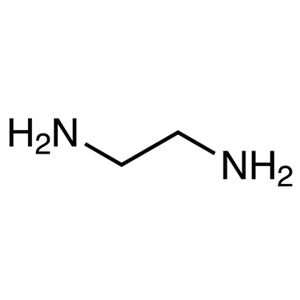
EthylenediamineAnhydrous TCI E0077
Regular price From Rp 505.050,00Regular priceRp 352.800,00Sale price From Rp 505.050,00 -
1,11-Diaminoundecane TCI D2075
Regular price From Rp 2.147.250,00Regular priceRp 1.501.500,00Sale price From Rp 2.147.250,00 -
1,4-Diaminobutane TCI D0239
Regular price From Rp 505.050,00Regular priceRp 352.800,00Sale price From Rp 505.050,00