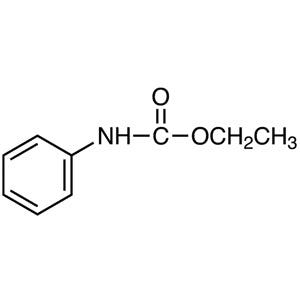
Phenylurethane from TCI, also known as ethyl N-phenylcarbamate, is an aromatic carbamate compound. Its structure consists of an anilino group bonded to an ethoxycarbonyl group. It is classed as a non-heterocyclic building block and represents the urethane class, a functional group that matters in polymer chemistry, agrochemistry, and pharmaceutical science. In the laboratory, researchers use it as a starting material for synthesis, as a model compound for studying how the carbamate bond reacts, and as a reference compound in studies of urethane formation and breakdown.
Researchers choose Phenylurethane because its structure is simple but still contains a complete carbamate group. The N-aryl carbamate bond is fairly stable under ordinary conditions. Under certain conditions, though, it can be cleaved, for example by hydrolysis or by thermolysis that releases an isocyanate. This makes the compound useful for mechanistic studies and for phosgene-free routes to isocyanates. The carbamate N-H group can be modified further, for example by alkylation or acylation. The phenyl ring can take part in aromatic substitution, and it absorbs UV light, which helps with chromatographic analysis.
In Indonesia, this material is useful to organic chemistry laboratories at universities, research institutes, and industrial R&D facilities. Groups working on polymer and polyurethane chemistry can use it as a simple model for urethane linkages. Synthetic chemistry groups can use it as a starting point for building more functionalised carbamate derivatives. Analytical and teaching laboratories can also use it as a well-defined reference compound when showing how carbamates form, how they react, and how they can be detected by chromatography.
Related TCI products
- Organic synthesis starting material: the carbamate N-H group and the phenyl ring can both be modified further, so the compound can be built into more complex carbamate derivatives.
- Model compound for carbamate reactivity: its simple structure contains a complete carbamate group, so researchers can study the bond's behaviour without interference from other functional groups.
- Reference compound in urethane formation and breakdown studies: it represents the urethane class clearly, so it works well as a benchmark when comparing how urethane bonds form or cleave.
- Phosgene-free isocyanate route research: the N-aryl carbamate bond can be cleaved by thermolysis to give an isocyanate, which is useful when studying alternatives to phosgene.
- Chromatographic analysis and method work: the phenyl ring absorbs UV light, so the compound can be detected in chromatographic separations of carbamate-containing samples.
| Brand | TCI (product code P0165) |
|---|---|
| CAS number | 101-99-5 |
| Molecular formula | — |
| Purity | — |
| Category | Chemistry > Building Blocks > Non-Heterocyclic Building Blocks |
| Pack sizes | available in the pack sizes offered by TCI; ask AMI Scientific which options are available |
| Physical form | — |
| Storage | follow the conditions on the TCI label and Safety Data Sheet |
- Synonym: Ethyl N-phenylcarbamate
Keep Phenylurethane in its original tightly closed container, in a cool, dry, well-ventilated place away from direct sunlight, heat sources, and moisture. Store it apart from strong acids, strong bases, and oxidising agents, because the carbamate bond can be broken by hydrolysis. Use clean, dry glass or chemically compatible containers when you transfer it. Handle the compound in a fume hood and wear standard protective equipment, including gloves, safety glasses, and a lab coat. Avoid breathing in dust or vapour and avoid contact with skin and eyes. Read the TCI Safety Data Sheet before use and dispose of waste according to local regulations.
—
Produk Terkait
-
Phenylurethane TCI P1090
Regular price From Rp 557.550,00Regular price -
N-Hydroxyurethane TCI H0618
Regular price From Rp 769.650,00Regular price