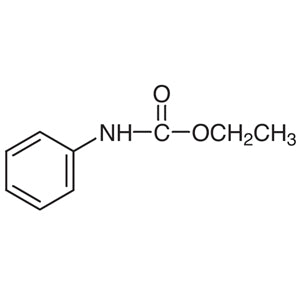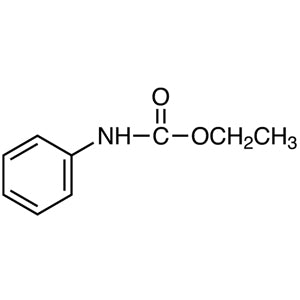
Phenylurethane from TCI, also known as ethyl N-phenylcarbamate, is an aromatic carbamate. It is formed from a phenylamine group and the ethyl ester of carbamic acid. It is classed as a non-heterocyclic building block and is useful in organic synthesis and polymer chemistry. In the laboratory, Phenylurethane serves as a model compound for the urethane linkage, an intermediate for making urea and carbamate derivatives, and a reference material in polyurethane studies. Its simple structure makes it well suited for studying how the carbamate group behaves without interference from other structural features.
Phenylurethane is widely chosen because it is the simplest example of the aromatic urethane linkage, which is the core bond in polyurethane materials. The compound is relatively stable under ordinary conditions and is easier to handle than isocyanates. Researchers use it to study carbamate transesterification, thermal regeneration of isocyanates, and the spectroscopic behaviour of the urethane N–H and C=O groups. In synthesis, its carbamate group can also act as an amine protecting group, or as a precursor to urea derivatives through reaction with amines. This combination of simplicity, stability and reactivity makes it a dependable choice for both teaching and research.
In Indonesia, Phenylurethane is relevant to chemistry laboratories at universities, research institutions and industrial R&D facilities working in organic synthesis and polymer science. Teams studying polyurethane chemistry, coatings, foams or adhesives can use it as a simple model of the urethane bond before moving to more complex systems. Academic groups can use it in coursework and thesis research on carbamate reactivity and spectroscopy. Synthetic chemists may also keep it as a reliable intermediate for preparing urea and carbamate derivatives in multistep routes.
Related TCI products
- Urethane linkage model studies: As the simplest aromatic urethane, Phenylurethane lets researchers study the carbamate bond without interference from other structural features.
- Polyurethane research reference: It serves as a reference material when studying polyurethane formation, degradation and structure, because it represents the core linkage of these polymers.
- Carbamate transesterification and isocyanate regeneration: Its relative stability and well-defined structure make it suitable for studying carbamate transesterification and the thermal regeneration of isocyanates under controlled laboratory conditions.
- Spectroscopic characterization: Phenylurethane provides clear urethane N–H and C=O groups, making it a practical standard for interpreting infrared and other spectroscopic data on carbamate-containing materials.
- Synthesis of urea and carbamate derivatives: Its carbamate group can act as an amine protecting group or react with amines to form urea derivatives, which makes it a versatile intermediate.
| Brand | TCI (product code P1090) |
|---|---|
| CAS number | 101-99-5 |
| Molecular formula | — |
| Purity | — |
| Category | Chemistry > Building Blocks > Non-Heterocyclic Building Blocks |
| Pack sizes | Available in standard TCI pack sizes; please contact AMI Scientific to confirm current options |
| Physical form | — |
| Storage | Store according to the manufacturer's label and Safety Data Sheet (SDS) |
- Synonym: Ethyl N-phenylcarbamate
Store Phenylurethane in its original tightly closed container in a cool, dry and well-ventilated area, away from direct sunlight, heat sources, moisture and incompatible substances such as strong oxidizing agents, strong acids and strong bases. Keep the container clearly labelled and reseal it promptly after each use to protect the contents. Handle the material in a fume hood or well-ventilated workspace, and wear suitable protective equipment, including gloves, safety glasses and a lab coat. Avoid creating dust, inhaling it, or letting it touch skin and eyes. Always read the product Safety Data Sheet before use, and dispose of waste according to local regulations and institutional laboratory safety procedures.
—
Produk Terkait
-
Phenylurethane TCI P0165
Regular price From Rp 505.050,00Regular price -
N-Hydroxyurethane TCI H0618
Regular price From Rp 769.650,00Regular price