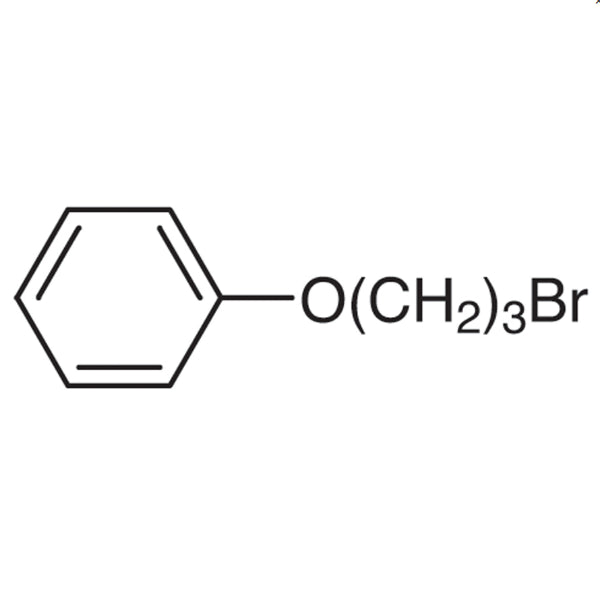
3-Phenoxypropyl Bromide from TCI (product code P1027) is a primary alkyl bromide with a phenoxy group at the end of a propyl chain. It is also known as (3-bromopropoxy)benzene. In synthesis laboratories, it is used as an alkylating agent to attach a 3-phenoxypropyl chain to nitrogen, oxygen, sulfur, or carbon atoms. This aryl ether motif, joined through a three-carbon chain, is common in the design of bioactive compounds and ligands. That makes this reagent a practical building block for many synthetic programmes.
Chemists choose this material because the bromine atom sits on a primary carbon. There it is a good leaving group for SN2 nucleophilic substitution, with very little steric hindrance. Its reactions with amines, phenoxides, thiolates, and carbanions generally proceed smoothly under mildly basic conditions. The phenoxy group is fairly stable and is not easily disturbed during alkylation. The propyl chain also provides a flexible spacer between the aromatic ring and the reaction centre. This matters when tuning the conformation and physicochemical properties of the target molecule.
In Indonesia, 3-Phenoxypropyl Bromide is useful to medicinal chemistry, organic synthesis, and materials research laboratories that need an aryl ether linker. University research groups, pharmaceutical development teams, and institutional laboratories can use it to prepare tertiary amine derivatives, quaternary ammonium salts, and other compounds that carry a phenoxypropyl unit. Because it comes from TCI, it fits well into established synthetic workflows where reagent consistency and clear product identification matter for reproducible results.
- N-alkylation of amines: the primary bromide reacts readily with primary and secondary amines under mild base. This makes it suitable for preparing tertiary amine derivatives that carry a 3-phenoxypropyl chain.
- Quaternary ammonium salt preparation: its low steric hindrance at the reactive carbon lets tertiary amines be alkylated efficiently. This gives ammonium salts with a flexible aryl ether side chain.
- O-alkylation of phenols and alcohols: phenoxide and alkoxide nucleophiles displace the bromide cleanly. This makes the reagent useful for building extended ether structures with a propyl spacer.
- S-alkylation of thiols: thiolate anions are strong nucleophiles toward primary alkyl bromides. This allows efficient synthesis of thioethers bearing a phenoxypropyl group for further study.
- C-alkylation of carbanions in medicinal chemistry: stabilised carbanions can be alkylated to introduce the aryl ether linker. This helps researchers adjust conformation and physicochemical properties in bioactive compound and ligand design.
| Brand | TCI (product code P1027) |
|---|---|
| CAS number | 588-63-6 |
| Molecular formula | — |
| Purity | — |
| Category | Chemistry > Building Blocks > Non-Heterocyclic Building Blocks |
| Pack sizes | as listed on the product page |
| Physical form | — |
| Storage | keep tightly closed in a cool, dry, well-ventilated place, following the TCI label and SDS |
- Synonym: (3-Bromopropoxy)benzene
Store 3-Phenoxypropyl Bromide in its original, tightly sealed container. Keep it in a cool, dry, well-ventilated area away from direct sunlight, heat sources, strong bases, and strong oxidising agents. Keep the container closed when not in use to limit exposure to moisture and air. As an alkylating agent, it should be handled in a fume hood with suitable gloves, safety glasses, and a laboratory coat. Avoid skin contact, eye contact, and breathing in vapours. Always check the Safety Data Sheet supplied by TCI for specific hazard information. Dispose of residues and contaminated materials according to local regulations for halogenated organic waste.
—
Produk Terkait
-
2-Phenoxypropanol TCI P1111
Regular price From Rp 3.287.550,00Regular price -
2-PhenoxypropionylChloride TCI P0638
Regular price From Rp 1.298.850,00Regular price -
2-Bromo-5-methoxybenzylBromide TCI B4423
Regular price From Rp 1.298.850,00Regular price -
4-PhenoxybutylBromide TCI P1851
Regular price Rp 1.829.100,00Regular price -
5-PhenoxyamylBromide TCI P1847
Regular price Rp 1.538.250,00Regular price -
2-Hydroxy-5-nitrobenzylBromide TCI H0601
Regular price Rp 1.193.850,00Regular price -
3,5-DimethoxybenzylBromide TCI D2657
Regular price From Rp 1.670.550,00Regular price -
2-Hydroxy-3-phenoxypropylAcrylate(stabilizedwithMEHQ) TCI H1614
Regular price From Rp 875.700,00Regular price