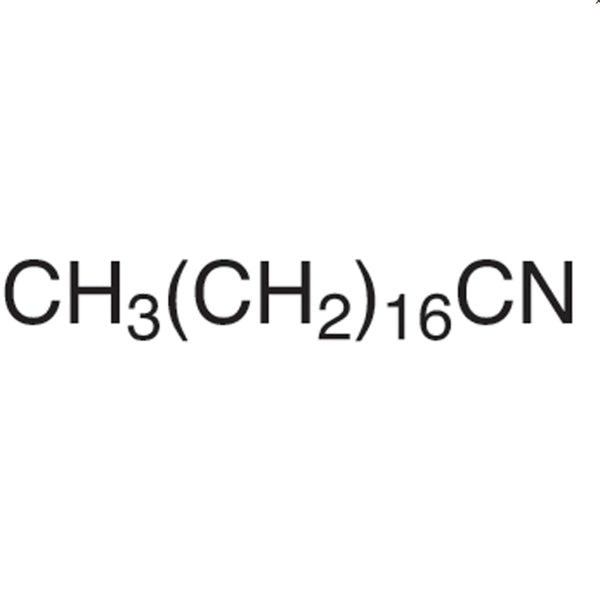
Stearonitrile from TCI, also known as octadecanenitrile, is an aliphatic nitrile with a long, saturated carbon chain. It belongs to the class of non-heterocyclic building blocks. In the laboratory, Stearonitrile serves as an intermediate in the synthesis of long-chain nitrogen compounds. Examples include fatty amines obtained by reduction, and amides or carboxylic acids obtained by hydrolysis. These derivatives are in turn the starting materials for cationic surfactants, antistatic agents, and corrosion inhibitors, which makes this compound a useful entry point for applied organic synthesis work.
Chemists choose Stearonitrile because its nitrile group is a versatile synthetic handle. Through well-established reactions in organic chemistry, it can be converted into primary amines, amides, carboxylic acids, or ketones. The saturated C18 chain makes the resulting products strongly hydrophobic, and they behave like surfactants once a polar head group is attached. The compound is also relatively stable under normal storage conditions. The 5 g and 25 g pack sizes suit both early exploration of synthetic routes and later reaction optimization, so laboratories can scale their purchase to the stage of their project.
In Indonesia, Stearonitrile is relevant to organic chemistry and oleochemical laboratories that develop nitrogen-containing derivatives of palm-based fatty acids. Typical targets include fatty amines used in surfactants and fabric softeners. University research groups, industrial R&D teams, and pilot-scale oleochemical laboratories can use it as a well-defined model compound or intermediate. It helps them study how long-chain nitrile chemistry turns locally sourced fatty acid feedstocks into higher-value functional products.
- Fatty amine synthesis by reduction: the nitrile group reduces to a primary amine, giving access to long-chain C18 amines that serve as starting materials for cationic surfactants.
- Hydrolysis to amides and carboxylic acids: well-established hydrolysis reactions turn the nitrile into the matching amide or acid, so researchers can study derivatives along a single saturated chain.
- Ketone preparation: as a versatile synthetic handle, the nitrile group can be converted into ketones, which broadens the range of long-chain targets available from a single building block.
- Surfactant and antistatic agent development: the strongly hydrophobic C18 chain gives derivatives surfactant-like behavior once a polar head group is attached, which makes it well suited to formulation research.
- Oleochemical and corrosion inhibitor research: it is a useful intermediate for laboratories that make nitrogen-containing derivatives of fatty acids, including compounds tested as corrosion inhibitors and fabric softener components.
| Brand | TCI (product code S0085) |
|---|---|
| CAS number | 638-65-3 |
| Molecular formula | — |
| Purity | — |
| Category | Chemistry > Building Blocks > Non-Heterocyclic Building Blocks |
| Pack sizes | 5 g and 25 g |
| Physical form | refer to the TCI label and certificate of analysis; relatively stable under normal storage conditions |
| Storage | — |
- Synonym: Octadecanenitrile
Store Stearonitrile in its original tightly closed container in a cool, dry, well-ventilated area. Keep it away from heat sources, direct sunlight, and incompatible substances such as strong oxidizing agents, strong acids, and strong bases. Reseal the container promptly after each use so it does not absorb moisture or get contaminated. Handle the material in a fume hood or another well-ventilated workspace, and wear standard personal protective equipment, including a lab coat, safety glasses, and chemical-resistant gloves. Avoid inhaling dust or vapor and avoid contact with skin and eyes. Always read the Safety Data Sheet (SDS) supplied by TCI before use. Dispose of waste and residues according to local regulations and your institution's chemical waste procedures.
—
Produk Terkait
-
2-Bromo-2-(bromomethyl)glutaronitrile TCI B5387
Regular price From Rp 875.700,00Regular price -
2-Methylglutaronitrile TCI M0331
Regular price Rp 1.167.600,00Regular price -
3-Hydroxyglutaronitrile TCI H0897
Regular price From Rp 2.121.000,00Regular price -
Glutaronitrile TCI G0072
Regular price From Rp 2.199.750,00Regular price -
Fumaronitrile TCI F0072
Regular price From Rp 980.700,00Regular price -
Valeronitrile TCI V0008
Regular price From Rp 743.400,00Regular price -
5-Bromovaleronitrile TCI B1453
Regular price From Rp 1.087.800,00Regular price -
3-Bromobutyronitrile TCI B1452
Regular price From Rp 1.961.400,00Regular price