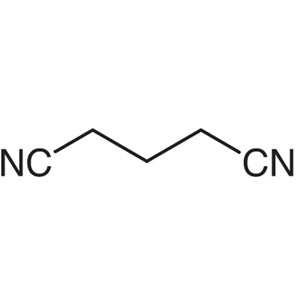
TCI G0072 Glutaronitrile is an aliphatic dinitrile built on a five-carbon chain with a cyano group at each end, supplied as a liquid. In the laboratory it plays two roles at once: it serves as a bifunctional building block in organic synthesis and as a polar aprotic solvent for selected reactions. The nitrile groups can be converted into primary amines through hydrogenation, into carboxylic acids or amides through hydrolysis, and can take part in a range of addition reactions, so a single material opens many routes toward other five-carbon derivatives.
The properties that make it a frequent choice begin with the high dielectric constant characteristic of nitrile compounds, together with a relatively high boiling point that keeps it from evaporating readily under moderate heating, and its ability to dissolve inorganic salts and polar compounds that are difficult to dissolve in ordinary organic solvents. As a building block, the symmetry of the molecule simplifies synthetic planning because both ends react equivalently. Its liquid form allows direct pipetting and rapid mixing, which is practical for small- and medium-scale reactions at the laboratory bench.
In Indonesia, this material is generally used by chemistry laboratories that carry out organic synthesis and related preparative work, where a bifunctional five-carbon intermediate and a polar aprotic medium are both needed. Because it arrives as a ready-to-use liquid, it fits routine bench workflows without additional preparation, supporting research groups and analytical or development laboratories that prepare derivatives on a small to medium scale.
- Bifunctional building block in organic synthesis, where the two equivalent cyano ends let a chemist extend or link structures symmetrically and simplify the planning of multi-step routes.
- Preparation of primary amines by hydrogenation of the nitrile groups, giving access to five-carbon diamine-type derivatives from a single readily pipetted liquid starting material.
- Hydrolysis to carboxylic acids or amides, allowing one stock material to be directed toward several different functional group families depending on the reaction conditions chosen.
- Polar aprotic reaction solvent, where the high dielectric constant typical of nitriles supports reactions that require a strongly polarizing but non-hydrogen-bonding medium.
- Dissolution of inorganic salts and polar compounds that resist ordinary organic solvents, useful when a reaction mixture must keep such species in solution during moderate heating.
| Brand | TCI |
|---|---|
| CAS number | 544-13-8 |
| Molecular formula | — |
| Purity | — |
| Category | Chemistry > Building Blocks > Non-Heterocyclic Building Blocks |
| Pack sizes | available in standard TCI catalogue pack sizes; please confirm the size required when ordering |
| Physical form | liquid |
| Storage | store in a closed container in a cool, well-ventilated area away from incompatible materials |
Keep the container tightly closed and store it in a cool, dry and well-ventilated place, away from heat sources, ignition sources and incompatible chemicals. Original manufacturer packaging or compatible chemically resistant bottles are suitable; make sure closures seal properly and that containers stay clearly labelled. Handle the liquid inside a fume hood, wearing safety goggles, chemical-resistant gloves and a laboratory coat, and avoid contact with skin and eyes as well as inhalation of vapours. Transfer by pipette carefully to limit spillage, wipe up any residue immediately, and wash hands thoroughly after use. Always consult the manufacturer's safety data sheet before handling, and dispose of residues and contaminated materials in accordance with applicable chemical waste procedures.
—
Produk Terkait
-
2-Bromo-2-(bromomethyl)glutaronitrile TCI B5387
Regular price From Rp 875.700,00Regular price -
2-Methylglutaronitrile TCI M0331
Regular price Rp 1.167.600,00Regular price -
3-Hydroxyglutaronitrile TCI H0897
Regular price From Rp 2.121.000,00Regular price -
Stearonitrile TCI S0085
Regular price From Rp 743.400,00Regular price -
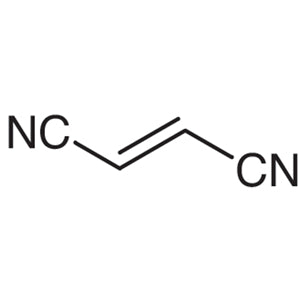
Fumaronitrile TCI F0072
Regular price From Rp 980.700,00Regular price -
Butyronitrile TCI B0768
Regular price From Rp 610.050,00Regular price -
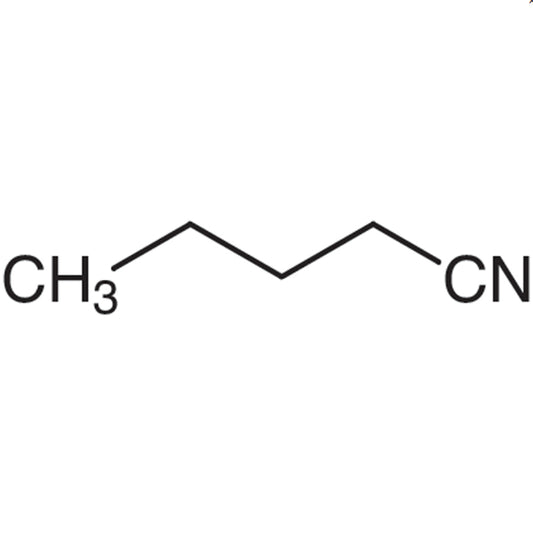
Valeronitrile TCI V0008
Regular price From Rp 743.400,00Regular price -
5-Bromovaleronitrile TCI B1453
Regular price From Rp 1.087.800,00Regular price