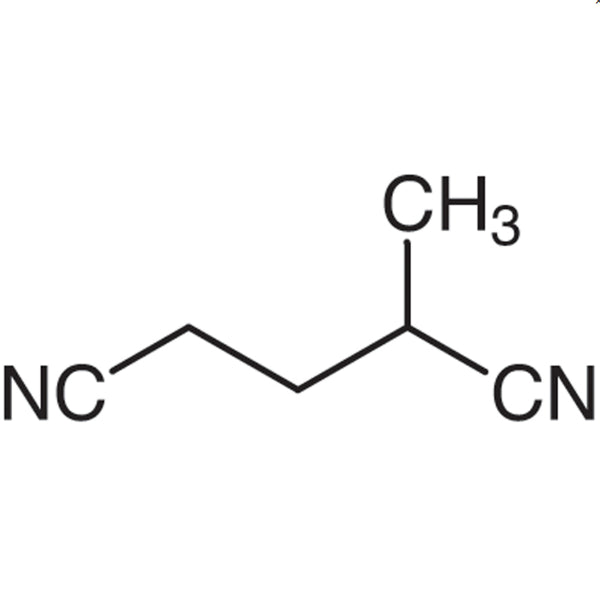
2-Methylglutaronitrile from TCI is a branched aliphatic dinitrile widely recognised as a companion compound in the production of adiponitrile via the hydrocyanation of butadiene. The molecule carries two cyano groups at the ends of a methyl-branched carbon chain, which makes it a valuable starting material for assembling diamines, diacids, lactams, and nitrogen-containing heterocyclic compounds. In the laboratory, 2-methylglutaronitrile is used as a precursor for the synthesis of 2-methyl-1,5-pentanediamine and 3-methylpiperidine, two building blocks that are widely employed in polymer research and medicinal chemistry.
The outstanding characteristic of this compound is the highly versatile reactivity of its nitrile groups. The cyano group can be hydrolysed to a carboxylic acid or an amide, reduced to a primary amine by catalytic hydrogenation or with metal hydrides, and added to by organometallic reagents to give ketones. The presence of two nitrile groups within a single molecule allows both double and stepwise selective transformations, while the branching methyl group creates a difference in the steric environment between the two ends of the chain. Its physical form is a colourless to pale yellow liquid of moderate viscosity with a high boiling point, which makes it convenient to handle and transfer in ordinary glassware.
In Indonesian laboratories, this building block is typically found in university and institutional synthetic chemistry groups, in polymer and materials research units, and in process development work where intermediates toward diamines and heterocycles are prepared on a bench scale. Because the material is supplied by TCI under the catalogue number M0331, it is generally ordered as part of a wider set of non-heterocyclic building blocks for multistep synthesis programmes, method development, and the preparation of reference materials for analytical work.
- Precursor to 2-methyl-1,5-pentanediamine, where complete reduction of both nitrile groups delivers a branched diamine used extensively as a monomer and curing component in polymer research programmes.
- Synthesis of 3-methylpiperidine, since reductive cyclisation of the dinitrile framework provides direct access to a substituted saturated nitrogen heterocycle frequently required in medicinal chemistry building-block libraries.
- Preparation of nitrogen heterocycles and lactams, because the two cyano groups on a branched chain offer the connectivity and ring size needed for cyclisation studies on heterocyclic scaffolds.
- Construction of diacids and diamides through controlled hydrolysis of the nitrile functions, giving researchers a convenient entry point to branched bifunctional carboxyl compounds for polycondensation studies.
- Model substrate for selective and stepwise nitrile chemistry, as the methyl branch differentiates the steric environment of each chain terminus and allows monofunctionalisation to be examined systematically.
| Brand | TCI (catalogue number M0331) |
|---|---|
| CAS number | 4553-62-2 |
| Molecular formula | — |
| Purity | — |
| Category | Chemistry > Building Blocks > Non-Heterocyclic Building Blocks |
| Pack sizes | available in the standard TCI research-scale packaging options; please confirm the size required when ordering |
| Physical form | colourless to pale yellow liquid, moderately viscous with a high boiling point |
| Storage | keep in a cool, well-ventilated place in a tightly closed original container |
Store 2-Methylglutaronitrile in its tightly closed original container, kept in a cool, dry and well-ventilated area away from strong oxidising agents, strong acids, strong bases, and sources of heat or ignition. Containers should be chemically compatible glass or the supplier's own packaging, kept upright and clearly labelled, with the closure secured immediately after each withdrawal to limit moisture uptake and vapour release. All handling, transfer, and reaction setup should be carried out inside a functioning fume hood, using nitrile gloves, safety goggles, and a laboratory coat as the minimum personal protective equipment. Nitriles require careful handling, so avoid skin contact, inhalation of vapour, and any procedure that generates aerosols; keep spill absorbent material and an eyewash station accessible, and collect waste as designated chemical waste rather than discharging it to the drain. Always consult the manufacturer's safety data sheet before first use.
—
Produk Terkait
-
Glutaronitrile TCI G0072
Regular price From Rp 2.199.750,00Regular price -
2-Bromo-2-(bromomethyl)glutaronitrile TCI B5387
Regular price From Rp 875.700,00Regular price -
3-Hydroxyglutaronitrile TCI H0897
Regular price From Rp 2.121.000,00Regular price -
Stearonitrile TCI S0085
Regular price From Rp 743.400,00Regular price -
Fumaronitrile TCI F0072
Regular price From Rp 980.700,00Regular price -
2-MethylglutaricAcid TCI M1300
Regular price From Rp 1.167.600,00Regular price -
3-MethylglutaricAnhydride TCI M1010
Regular price Rp 2.439.150,00Regular price -
3-MethylglutaricAcid TCI M0330
Regular price From Rp 1.140.300,00Regular price