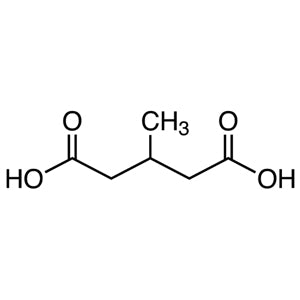
3-Methylglutaric Acid from TCI is a branched aliphatic dicarboxylic acid carrying a methyl group at the central position of a five-carbon chain. The presence of two structurally equivalent carboxyl groups makes this compound a highly useful starting material for forming cyclic anhydrides, diesters, diamides, and condensation polymers. In the biochemical field, 3-methylglutarate is known as a metabolite associated with the leucine metabolic pathway, so the compound is frequently required as a reference material in metabolism research and in the development of organic acid analytical methods. It belongs to the non-heterocyclic building blocks group within synthetic chemistry.
The properties that make this compound a preferred choice are its distinctive structural symmetry and the readily controllable reactivity of its carboxyl groups. Because the two carboxyl groups are enantiotopic, this compound and its anhydride serve as classic substrates for asymmetric desymmetrization reactions that generate chiral products from an achiral starting material. Its physical form is a white crystalline solid that is stable at room temperature and soluble in water and polar solvents, so it is easy to weigh accurately, purify by recrystallization, and formulate as a standard solution. The methyl group on the chain also exerts a useful conformational influence during ring formation and derivatization work.
In Indonesian laboratories, this material is typically used in university and institutional synthetic chemistry groups building non-heterocyclic intermediates, and in clinical biochemistry and metabolomics laboratories that need an organic acid reference for method development. Its stability at ambient temperature and its solubility in water and polar solvents suit local working conditions, allowing straightforward weighing, recrystallization, and preparation of standard solutions without specialized handling infrastructure.
- Cyclic anhydride preparation: the two equivalent carboxyl groups readily close to form 3-methylglutaric anhydride, giving a reliable route to a reactive intermediate for further derivatization.
- Asymmetric desymmetrization studies: the enantiotopic carboxyl groups make this acid and its anhydride classic substrates for producing chiral products from an achiral, inexpensive, symmetric starting material.
- Diester and diamide synthesis: both carboxyl groups react in a controllable manner, allowing systematic preparation of symmetric or selectively mono-functionalized derivatives for structure-activity work.
- Condensation polymer research: as a difunctional monomer it participates in polyester and polyamide condensation, with the central methyl branch influencing chain conformation and resulting material properties.
- Organic acid analytical method development: as a leucine-pathway-related metabolite it serves as a reference substance when establishing and validating organic acid determination methods in metabolism research.
| Brand | TCI |
|---|---|
| CAS number | 626-51-7 |
| Molecular formula | — |
| Purity | — |
| Category | Chemistry > Building Blocks > Non-Heterocyclic Building Blocks |
| Pack sizes | available in the standard TCI catalogue pack sizes for this item; please confirm the required quantity when ordering |
| Physical form | white crystalline solid, soluble in water and polar solvents |
| Storage | stable at room temperature; store in a tightly closed container in a dry place |
Store 3-Methylglutaric Acid in its original tightly closed container in a cool, dry, well-ventilated area away from moisture, since crystalline organic acids can absorb atmospheric water and cake during prolonged storage. Glass bottles with chemically resistant caps are suitable, and the container should be reclosed immediately after each weighing to preserve material quality. Handle the solid in a fume hood or a well-ventilated weighing area to avoid dust inhalation, and wear safety goggles, gloves, and a laboratory coat. As with all carboxylic acids, avoid contact with skin and eyes, keep the material separated from strong bases and strong oxidizing agents, and consult the manufacturer's safety data sheet before use and disposal.
—
Produk Terkait
-
2-MethylglutaricAcid TCI M1300
Regular price From Rp 1.167.600,00Regular price -
3-MethylglutaricAnhydride TCI M1010
Regular price Rp 2.439.150,00Regular price -
3-Hydroxy-3-methylglutaricAcid TCI H0436
Regular price Rp 5.803.350,00Regular price -
3-Ethyl-3-methylglutaricAcid TCI E0285
Regular price Rp 3.525.900,00Regular price -
2,2-DimethylglutaricAcid TCI D1786
Regular price Rp 5.644.800,00Regular price -
2,2-DimethylglutaricAnhydride TCI D1325
Regular price From Rp 3.155.250,00Regular price -
3,3-DimethylglutaricAnhydride TCI D1323
Regular price From Rp 1.060.500,00Regular price -
3,3-DimethylglutaricAcid TCI D1322
Regular price From Rp 2.809.800,00Regular price