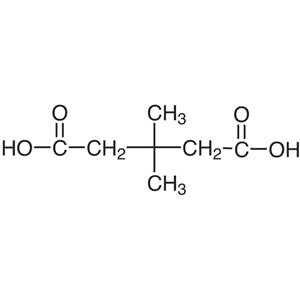
TCI D1323 3,3-Dimethylglutaric Anhydride is the cyclic anhydride form of 3,3-dimethylglutaric acid, consisting of a six-membered ring that contains two carbonyl groups linked through a single oxygen atom. As a non-heterocyclic building block, this compound serves as a highly practical acylating reagent in organic synthesis laboratories. When it is reacted with alcohols, amines, or water, the anhydride ring opens and immediately yields the corresponding monoester, monoamide, or reverts to the parent diacid. This allows researchers to obtain a molecule bearing one protected terminus and one free carboxyl terminus in a single clean reaction step.
The property that makes this reagent widely preferred is its high yet controlled ring reactivity. Ring strain combined with polarization of the carbonyl groups allows nucleophilic attack to proceed under mild conditions, frequently without requiring an additional activating agent such as a carbodiimide. The two geminal methyl groups positioned at the centre of the ring help stabilize the cyclic form while simultaneously imparting conformational rigidity to the derivative products obtained from it. This combination of accessible reactivity and structural definition gives synthetic chemists predictable outcomes and straightforward reaction workups.
The compound exists as a solid at room temperature, which makes it convenient to weigh out accurately on an analytical balance during routine bench work in Indonesian laboratories. However, it is sensitive to humidity, because moisture will hydrolyse the anhydride ring back to the free diacid and diminish the effectiveness of the reagent. Given the consistently humid ambient conditions found across Indonesia, university research laboratories, chemical synthesis groups, and industrial R&D units generally handle this material with attention to moisture exclusion during weighing and transfer operations.
- Monoester preparation — reaction with an alcohol opens the anhydride ring in one step, delivering a product carrying an ester at one end and a free carboxylic acid at the other.
- Monoamide synthesis — treatment with primary or secondary amines cleanly furnishes amide linkages while leaving the second carboxyl group available for subsequent coupling or functionalization work.
- Selective acylation of nucleophilic substrates — the polarized carbonyl centres permit acyl transfer under mild conditions, often removing the need for separate carbodiimide-type activating reagents entirely.
- Introduction of conformational rigidity — the geminal dimethyl substitution transfers structural constraint into derivative molecules, which is valuable when a defined spatial arrangement is required.
- Bifunctional linker construction — the resulting free carboxyl terminus gives a convenient handle for building longer chains, conjugates, or tethered structures in multi-step synthesis.
| Brand | TCI |
|---|---|
| CAS number | 4160-82-1 |
| Molecular formula | — |
| Purity | — |
| Category | Chemistry > Building Blocks > Non-Heterocyclic Building Blocks |
| Pack sizes | available in standard TCI catalogue pack sizes; please confirm the required quantity when ordering |
| Physical form | solid at room temperature |
| Storage | keep tightly closed and protected from moisture |
Store this compound in a tightly closed container in a cool, dry location, away from moisture, since water hydrolyses the anhydride ring back to the free diacid and reduces reagent performance. Amber glass bottles or the original supplier container with a well-seated cap are suitable; a desiccator or a sealed secondary container with desiccant offers additional protection under humid conditions. Weigh and transfer the solid promptly, closing the container immediately afterwards to limit atmospheric exposure. Handle in a fume hood using gloves, safety goggles, and a laboratory coat, and avoid contact with skin, eyes, and inhalation of dust. Keep separated from strong bases, alcohols, amines, and other nucleophilic reagents during storage.
—
Produk Terkait
-
2,2-DimethylglutaricAnhydride TCI D1325
Regular price From Rp 3.155.250,00Regular price -
2,2-DimethylglutaricAcid TCI D1786
Regular price Rp 5.644.800,00Regular price -
3,3-DimethylglutaricAcid TCI D1322
Regular price From Rp 2.809.800,00Regular price -
2-MethylglutaricAcid TCI M1300
Regular price From Rp 1.167.600,00Regular price -
3-MethylglutaricAnhydride TCI M1010
Regular price Rp 2.439.150,00Regular price -
3-MethylglutaricAcid TCI M0330
Regular price From Rp 1.140.300,00Regular price -
3-Hydroxy-3-methylglutaricAcid TCI H0436
Regular price Rp 5.803.350,00Regular price -
3-Ethyl-3-methylglutaricAcid TCI E0285
Regular price Rp 3.525.900,00Regular price