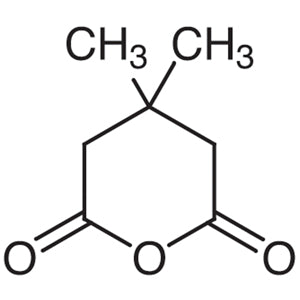
TCI D1325 2,2-Dimethylglutaric Anhydride is the cyclic anhydride of 2,2-dimethylglutaric acid, in which two methyl groups are attached to the carbon directly adjacent to one of the carbonyl groups. As a non-heterocyclic building block, this compound serves as an acylating reagent capable of introducing a branched carboxylic acid chain into a target molecule in a single step. When the ring is opened by a nucleophile such as an amine or an alcohol, the result is a monoamide or monoester bearing a free carboxyl group at the other end, which makes it particularly useful in the assembly of linkers and stepwise synthetic intermediates.
The characteristic value of this compound compared with its 3,3-isomer lies in the asymmetric placement of the branching. Because the two methyl groups sit immediately next to one carbonyl, nucleophilic attack tends to occur at the less sterically hindered carbonyl, so ring opening can proceed regioselectively and deliver more controlled derivative products. The quaternary carbon that is formed also confers additional resistance to further reaction at the alpha position and adds rigidity to the resulting structure. The compound is a solid at room temperature and is moisture-sensitive, so it is normally handled under conditions that limit contact with atmospheric humidity.
In Indonesian laboratories, this material is typically used in organic synthesis and medicinal chemistry research groups at universities, government research institutes, and industrial R&D units that prepare functionalised intermediates in house. It is commonly drawn on when a short, branched diacid fragment must be attached to an amine or alcohol scaffold, and its supply as a packaged TCI reagent suits laboratories that need a consistent, catalogue-listed building block for repeatable multi-step routes.
- Amide linker construction — ring opening with a primary or secondary amine gives a monoamide with a free terminal carboxyl group, ready for a second coupling step.
- Monoester intermediate preparation — reaction with alcohols opens the ring in one operation and leaves a free acid handle for further esterification or activation.
- Regioselective acylation studies — the methyl branching next to one carbonyl directs nucleophiles to the less hindered site, making the reagent useful for controlled derivatisation work.
- Medicinal chemistry scaffold building — the gem-dimethyl quaternary carbon adds steric bulk and rigidity, useful when researchers want to restrict conformational freedom in a candidate structure.
- Stepwise intermediate synthesis — as a non-heterocyclic building block it introduces a branched carboxylic acid chain in a single step, shortening multi-stage synthetic sequences.
| Brand | TCI (Tokyo Chemical Industry) |
|---|---|
| CAS number | 2938-48-9 |
| Molecular formula | — |
| Purity | — |
| Category | Chemistry > Building Blocks > Non-Heterocyclic Building Blocks |
| Pack sizes | supplied in standard TCI catalogue pack sizes — please confirm the available packing when ordering |
| Physical form | solid at room temperature; moisture-sensitive |
| Storage | — |
- Catalogue code: D1325
Because the anhydride is moisture-sensitive, store the container tightly closed in a dry, well-ventilated area away from heat, direct sunlight, and sources of water or humid air. Keep the material in its original tightly sealed container, or transfer it to a clean, dry, chemically compatible bottle with a secure closure; a desiccator or a dry storage cabinet is preferable for opened stock. Weigh and transfer the solid promptly to limit exposure to atmospheric moisture, and reseal immediately after use. Handle in a fume hood using safety glasses, gloves, and a laboratory coat, avoid inhaling dust, keep it separated from strong bases, alcohols, amines, and other reactive nucleophiles, and consult the manufacturer's safety data sheet before use and disposal.
—
Produk Terkait
-
3,3-DimethylglutaricAnhydride TCI D1323
Regular price From Rp 1.060.500,00Regular price -
2,2-DimethylglutaricAcid TCI D1786
Regular price Rp 5.644.800,00Regular price -
3,3-DimethylglutaricAcid TCI D1322
Regular price From Rp 2.809.800,00Regular price -
2-MethylglutaricAcid TCI M1300
Regular price From Rp 1.167.600,00Regular price -
3-MethylglutaricAnhydride TCI M1010
Regular price Rp 2.439.150,00Regular price -
3-MethylglutaricAcid TCI M0330
Regular price From Rp 1.140.300,00Regular price -
3-Hydroxy-3-methylglutaricAcid TCI H0436
Regular price Rp 5.803.350,00Regular price -
3-Ethyl-3-methylglutaricAcid TCI E0285
Regular price Rp 3.525.900,00Regular price