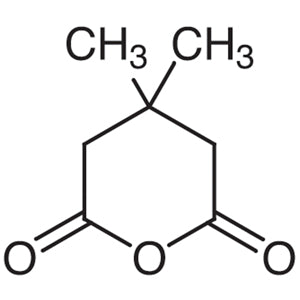
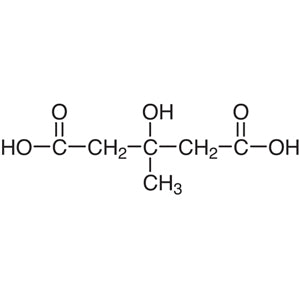
TCI D1322 3,3-Dimethylglutaric Acid is a five-carbon dicarboxylic acid carrying two methyl groups on the third carbon of the chain. It belongs to the non-heterocyclic building block class, meaning it is a small starting material used to assemble larger molecular frameworks in organic synthesis laboratories. Its role at the bench is fundamental: it supplies two carboxyl groups that are ready to be esterified, amidated, reduced, or cyclised into anhydrides and imides. For this reason it is widely used by researchers in medicinal chemistry, materials chemistry, and polymer chemistry as the starting point of synthetic routes that require a short-carbon spacer with fixed branching.
The characteristic that makes this compound a preferred choice lies in the two geminal methyl groups positioned at the middle of the chain. This branching produces a steric effect widely known as the gem-dimethyl effect, which generally pushes the two carboxyl ends closer together, so that ring-closing reactions proceed more readily than with ordinary glutaric acid. In addition, the branching hinders free rotation of the chain and adds mild lipophilic character to the derivatives prepared from it. Together these features give chemists a predictable, conformationally biased scaffold rather than a flexible, unconstrained one.
In Indonesian laboratories, this building block is typically used in university research groups, government research institutes, and industrial R&D units that carry out multi-step organic synthesis. It commonly appears in postgraduate and thesis-level work on synthetic route development, in the preparation of intermediates for medicinal chemistry screening programmes, and in polymer and materials studies where a short branched diacid is needed as a monomer or linker. It is normally ordered as a catalogue reagent alongside other TCI building blocks for planned synthetic campaigns.
- Anhydride and imide formation: the gem-dimethyl branching brings the two carboxyl ends closer together, so intramolecular ring closure to cyclic anhydrides and imides proceeds more readily than with unbranched glutaric acid.
- Diester synthesis: both carboxyl groups are available for esterification, allowing preparation of symmetrical or mono-functionalised diesters that serve as protected intermediates in longer multi-step organic synthesis sequences.
- Diamide and polyamide preparation: the two carboxyl functions can be amidated with mono- or diamines, making this diacid a convenient short branched monomer for amide-linked oligomers and polymers.
- Medicinal chemistry scaffold construction: the compound provides a rigidified short-carbon spacer with mild added lipophilicity, useful when tuning conformation and physicochemical behaviour of candidate molecules under study.
- Reduction to branched diols: the two carboxyl groups can be reduced to give the corresponding branched diol, supplying a hindered difunctional intermediate for further materials and polymer chemistry work.
| Brand | TCI |
|---|---|
| CAS number | 4839-46-7 |
| Molecular formula | — |
| Purity | — |
| Category | Chemistry > Building Blocks > Non-Heterocyclic Building Blocks |
| Pack sizes | available in the catalogue pack sizes offered for this TCI item |
| Physical form | — |
| Storage | store in a cool, dry place in a tightly closed container |
- Product code: D1322
Store the container tightly closed in a cool, dry, well-ventilated area away from moisture, direct sunlight, and incompatible materials such as strong bases and strong oxidising agents. The original manufacturer container is the most suitable packaging; if transferred, use a clean, chemically resistant, tightly sealing container that is clearly labelled with the compound name and CAS number. Handle the solid in a fume hood or a well-ventilated workspace, and wear a laboratory coat, safety goggles, and chemically resistant gloves. Avoid generating dust, and avoid contact with skin and eyes. Keep the container closed when not in use to limit moisture uptake, and always consult the manufacturer safety data sheet before handling and disposal.
—
Produk Terkait
-
2,2-DimethylglutaricAcid TCI D1786
Regular price Rp 5.644.800,00Regular price -
2,2-DimethylglutaricAnhydride TCI D1325
Regular price From Rp 3.155.250,00Regular price -
3,3-DimethylglutaricAnhydride TCI D1323
Regular price From Rp 1.060.500,00Regular price -
2-MethylglutaricAcid TCI M1300
Regular price From Rp 1.167.600,00Regular price -
3-MethylglutaricAnhydride TCI M1010
Regular price Rp 2.439.150,00Regular price -
3-MethylglutaricAcid TCI M0330
Regular price From Rp 1.140.300,00Regular price -
3-Hydroxy-3-methylglutaricAcid TCI H0436
Regular price Rp 5.803.350,00Regular price -
3-Ethyl-3-methylglutaricAcid TCI E0285
Regular price Rp 3.525.900,00Regular price