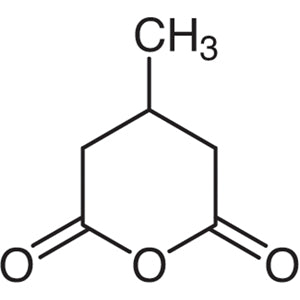
TCI M1010 3-Methylglutaric Anhydride is a six-membered cyclic acid anhydride bearing a methyl group at the third position of the glutarate chain, supplied by TCI as a synthesis raw material for organic chemistry laboratories. The compound belongs to the non-heterocyclic building block group, meaning it serves as a construction material for molecular frameworks that are reacted further into more complex structures. In the laboratory, its role is to act as a source of two active carbonyl groups ready to be opened by nucleophiles, allowing researchers to install a carboxylic acid chain together with an ester or amide group in a single reaction step that is relatively simple and controllable.
The characteristic that makes this anhydride a frequent choice is its reactivity, which is far higher than that of its parent carboxylic acid, without requiring additional expensive coupling reagents. The anhydride ring opens readily with alcohols, amines, or water, producing half-ester or half-amide derivatives directly. The presence of the methyl group at the central position makes the molecule prochiral, so selective ring opening with a chiral catalyst can yield products bearing an ordered stereogenic centre. These combined properties give the reagent a useful balance between straightforward handling and versatile downstream transformation.
In Indonesian laboratories, this material is typically used in organic synthesis research groups at universities and in research institutes working on the preparation of intermediate compounds. It is drawn upon whenever a workflow calls for a reactive acylating agent that can introduce a substituted glutaric fragment into a target molecule. Teaching and method-development laboratories also employ it to demonstrate ring-opening chemistry, while formulation and materials groups use it where a difunctional acyl source is required as the starting point of a synthetic sequence.
- Half-ester synthesis: alcohols open the anhydride ring directly to give a product carrying both an ester group and a free carboxylic acid in one controlled step.
- Half-amide preparation: amines react with the two active carbonyl groups to yield amide derivatives without the need for additional expensive coupling reagents in the workflow.
- Asymmetric ring opening: the prochiral methyl group at the central position allows chiral catalysts to open the ring selectively and generate an ordered stereogenic centre.
- Molecular framework construction: as a non-heterocyclic building block, it introduces a substituted glutaric fragment that is elaborated further into more complex target structures.
- Acylation of nucleophiles: its reactivity, far higher than that of the parent carboxylic acid, makes it an efficient acyl source for alcohol, amine, and water-based nucleophiles.
| Brand | TCI |
|---|---|
| CAS number | 4166-53-4 |
| Molecular formula | — |
| Purity | — |
| Category | Chemistry > Building Blocks > Non-Heterocyclic Building Blocks |
| Pack sizes | available in standard laboratory pack sizes as listed for this catalogue item |
| Physical form | cyclic acid anhydride, six-membered ring |
| Storage | keep in a tightly closed container, protected from moisture |
Store this anhydride in a cool, dry place inside a tightly closed original container, since the anhydride ring is opened by water and the material is sensitive to atmospheric moisture. Use dry glassware and anhydrous solvents when weighing and transferring, and reseal the container promptly after each use. Handle in a fume hood while wearing gloves, safety goggles, and a laboratory coat, as reactive anhydrides can irritate skin, eyes, and the respiratory tract. Keep it separated from alcohols, amines, and other nucleophilic reagents in storage, and follow the safety data sheet supplied with the product for full precautions and disposal guidance.
—
Produk Terkait
-
2-MethylglutaricAcid TCI M1300
Regular price From Rp 1.167.600,00Regular price -
3-MethylglutaricAcid TCI M0330
Regular price From Rp 1.140.300,00Regular price -
3-Hydroxy-3-methylglutaricAcid TCI H0436
Regular price Rp 5.803.350,00Regular price -
3-Ethyl-3-methylglutaricAcid TCI E0285
Regular price Rp 3.525.900,00Regular price -
2,2-DimethylglutaricAcid TCI D1786
Regular price Rp 5.644.800,00Regular price -
2,2-DimethylglutaricAnhydride TCI D1325
Regular price From Rp 3.155.250,00Regular price -
3,3-DimethylglutaricAnhydride TCI D1323
Regular price From Rp 1.060.500,00Regular price -
3,3-DimethylglutaricAcid TCI D1322
Regular price From Rp 2.809.800,00Regular price