
Spin Coaters: How They Work, Controlling Film Thickness, and How to Choose One
UpdatedShare
Almost every lab that makes perovskite solar cells, OLEDs, sensors or polymer coatings relies on the same instrument: the spin coater. The principle is simple. A solution is dropped onto a flat substrate, the substrate spins quickly, centrifugal force spreads the liquid to the edges, the excess is thrown off, and the solvent evaporates to leave a uniform thin film. Thickness can be tuned from tens of nanometres to a few micrometres just by changing the spin speed and the solution concentration.
This article covers the stages of spin coating, the factors that set film thickness, the most common mistakes, and what to check before choosing a spin coater for your lab.
The four stages of spin coating
- Deposition. The solution is dispensed onto the substrate. In a static dispense the substrate is still; in a dynamic dispense it is already spinning slowly, which saves solution and often gives better coverage for solutions that wet the surface poorly.
- Spin-up. The substrate accelerates to the target speed and the liquid spreads across the surface.
- Spin-off. Excess liquid is thrown off the edges. The film thins rapidly in the first few seconds.
- Evaporation. The solvent evaporates and the film dries. Viscosity rises and the final thickness is locked in.
What sets film thickness
- Spin speed. Faster means thinner. Empirically, thickness scales roughly with 1/√ω: quadrupling the speed makes the film about half as thick. The exact relationship has to be calibrated for each solution.
- Solution concentration and viscosity. More concentrated solutions give thicker films. For large changes, adjusting concentration is more effective than adjusting speed.
- Solvent boiling point. Fast-evaporating solvents (chloroform) lock the film in early and tend to give thicker layers; high-boiling solvents (DMF, DMSO, chlorobenzene) give the film time to level out.
- Acceleration. The ramp rate affects how evenly the solution spreads before it starts to dry, especially on large substrates and with fast-drying solutions.
- Spin time. Once the film is dry, spinning longer no longer thins it. With high-boiling solvents, however, a time that is too short leaves the film wet.
Spin coating perovskite solar cells
Perovskite layers are usually made with a two-step program, for example a low speed to spread the solution followed by a high speed to thin the film. A few seconds before the program ends, an anti-solvent such as chlorobenzene or toluene is dropped on so that the perovskite crystallises all at once and the film becomes dense. The timing of this drop strongly affects the result, so a spin coater that stores multi-step programs and a syringe pump that dispenses at the same second every time help a lot with sample-to-sample consistency. Materials and layer stacks are covered in our article on perovskite solar cells.
The most common mistakes
- Radial striations and "comets". Usually caused by dust or particles. Filter the solution with a syringe filter, clean the substrate, and work in a clean area.
- Thicker edges (edge bead). Normal at the substrate edge, especially on square substrates. Keep the active device area away from the edge.
- Uncoated patches. The solution is not wetting the surface. Clean the substrate with sequential sonication followed by UV ozone treatment to raise the surface energy.
- Bent or shifting substrates. A vacuum chuck can bend thin or flexible substrates. A vacuum-free chuck design avoids this problem.
- Results that differ between operators. Manual dispensing is hard to repeat precisely. Store recipes as programs and use a syringe pump.
How to choose a spin coater
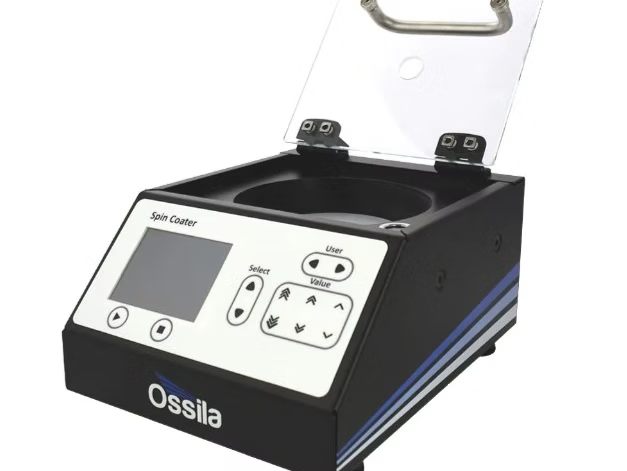
- Speed range and stability. Very thin films need high speeds; sensitive recipes need a small speed error. For example, the Ossila Spin Coater Standard (L2001A3) runs at 120 – 6,000 rpm with an error below 2%, while the Advanced model (L2001B2) runs at 500 – 10,000 rpm with an error below 0.25%.
- Acceleration control. Needed if your recipe depends on the ramp rate or for multi-step layers. The Advanced model can be programmed up to 4,000 rpm/s acceleration and 700 rpm/s deceleration.
- Programs and users. In a shared lab, separate user profiles stop recipes from being overwritten. Both Ossila models store 10 user profiles with programs of up to 50 steps.
- Vacuum or vacuum-free. A vacuum-free spin coater needs no pump, only a single power socket, and fits inside a glove box. This matters for perovskites processed under nitrogen.
- Substrate size and chuck. Make sure the chuck matches your substrate size (for example 20 x 15 mm, 25 x 25 mm or 50 x 50 mm) and is resistant to your solvents. PTFE is the choice for aggressive solvents such as DMF and DMSO.
- Automatic dispensing. A single or dual syringe pump is worth budgeting for if you use an anti-solvent step or make many samples.
Spin coaters and accessories at AMI Scientific
The Ossila Spin Coater Standard and Advanced, including configurations with a single or dual syringe pump and PP or PTFE chucks, are available in our Spin Coater collection. To prepare substrates and materials, see also ITO and FTO substrates, the UV Ozone Cleaner, perovskite materials and PEDOT:PSS. Once the film is made, its sheet resistance can be checked with a four point probe.
Send us your solution type, substrate size and target thickness via WhatsApp, and our team will help you choose a configuration and prepare an official quotation in your institution's name.