

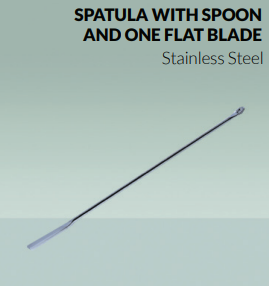
The OMM Stainless Steel Laboratory Spatula with Spoon and Flat Blade is a versatile tool for taking, transferring and measuring solid materials in the laboratory. It has two ends with different functions. One end is shaped like a spoon for scooping powders and granules. The other end is a flat blade for levelling, scraping or picking up small amounts of material. It is available in 150 mm and 180 mm lengths and is a basic item on almost every laboratory workbench.
Stainless steel is used because it is strong, does not rust easily, and stands up reasonably well to many of the chemicals commonly handled in the laboratory. Its smooth surface is easy to clean, which helps reduce the risk of cross-contamination between materials. A stainless spatula can also be heated or sterilised by the usual methods, so it is suitable for microbiology laboratories. Because it has two ends, one tool covers many tasks, from weighing reagents to moving samples into containers or dishes.
In Indonesian laboratories, spatulas like this are used every day by analysts, students and technicians. They are found in teaching laboratories, research facilities and routine testing laboratories. They are often kept next to analytical balances, in fume hoods and on general preparation benches. The two lengths let users choose a shorter spatula for close work at the balance or a longer one for reaching into deeper containers and reagent bottles.
- Reagent weighing: the spoon end lets analysts scoop powders and granules onto a weighing boat, and the flat blade helps them add or remove small amounts to reach the target mass.
- Sample transfer: the spatula moves solid samples cleanly from stock containers into beakers, flasks, crucibles or dishes, and its smooth stainless surface leaves little material behind.
- Levelling and scraping: the flat blade levels powder in a measuring container and scrapes residue from glassware walls or weighing paper so that no material is wasted.
- Microbiology work: stainless steel can be heated or sterilised by common laboratory methods, so the spatula can be used where clean, sterile handling of solid media is needed.
- Teaching laboratories: one durable, easy-to-clean tool with two working ends suits students learning basic solid-handling techniques during daily practical sessions.
| Brand | OMM |
|---|---|
| CAS number | — |
| Molecular formula | — |
| Purity | — |
| Category | IWAKI |
| Pack sizes | — |
| Physical form | — |
| Storage | keep clean and dry in a drawer or utensil holder away from corrosive substances |
- Available sizes: 150 mm and 180 mm length
- Material: stainless steel
- Form: double-ended spatula with a spoon end and a flat-blade end
After each use, clean the spatula thoroughly with water or a suitable laboratory detergent, then rinse it and dry it completely before storing. Store it in a clean, dry drawer, utensil rack or closed container so that dust and other contamination cannot build up. Keep it away from strongly corrosive chemicals and their fumes. Even though stainless steel resists rust, long exposure can still damage the surface. To prevent cross-contamination, use a separate clean spatula for each reagent, or clean it between materials. When you heat or sterilise the spatula, let it cool before touching it or using it with heat-sensitive samples. Wear appropriate gloves and eye protection whenever you handle hazardous chemicals.
—
Produk Terkait
-
Gelas Beker Plastik PP Bergagang AS ONE 1-4622
Regular price From Rp 127.000,00Regular price -
Gelas Beker Plastik PE Bergagang AS ONE 1-4626
Regular price From Rp 121.000,00Regular price -
Gelas Beker Plastik PP Tanpa Gagang Nikko 3573
Regular price From Rp 38.000,00Regular price -
Botol Laboratorium Mulut Sempit PP AS ONE 5-001
Regular price From Rp 22.000,00Regular price -
Botol Laboratorium Mulut Lebar PP AS ONE 5-002
Regular price From Rp 27.000,00Regular price -
Botol Laboratorium Mulut Sempit HDPE AS ONE 1-4657
Regular price From Rp 22.000,00Regular price -
Botol Laboratorium Mulut Lebar HDPE AS ONE 1-4658
Regular price From Rp 29.000,00Regular price -
Botol Laboratorium Mulut Lebar PC AS ONE 1-7403
Regular price From Rp 135.000,00Regular price


