

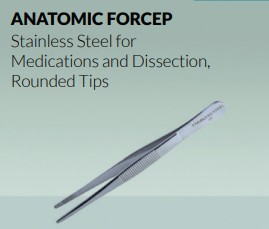
The OMM Round-Tip Stainless Steel Anatomical Forceps is a stainless steel anatomical tweezer with rounded tips and finely serrated transverse gripping surfaces. In the laboratory, it is used to hold, lift, and transfer tissue, specimens, cotton, gauze, and other small objects so they do not have to be handled directly by hand. Anatomical forceps differ from toothed (surgical) forceps because they have no sharp teeth at the tip. This makes them gentler on tissue and on materials that tear easily, so they are a basic tool for careful routine handling at the bench.
Several design features make this forceps a preferred choice. The rounded tips reduce the risk of puncturing or damaging specimens, plastic bags, membranes, or the user's gloves. The fine serrations on the gripping surfaces give enough grip to hold items securely without pressing too hard on them. The stainless steel body resists water and disinfectants and can be sterilized repeatedly by autoclave or dry heat, which suits work where cleanliness is critical. The forceps comes in five lengths, so users can choose between close-range precision and enough reach to work inside deep containers.
In Indonesia, anatomical forceps are widely used in biology and microbiology laboratories, where they are often handled every day for specimen preparation and general sample handling. Teaching laboratories, research facilities, and routine testing laboratories all depend on reliable, reusable instruments that can be cleaned and sterilized between tasks. A stainless steel forceps with rounded tips fits these settings well because it handles delicate materials gently, holds up under repeated decontamination, and comes in lengths suited to different benches and container sizes.
- Specimen handling: the smooth, rounded tips and fine serrations let users lift and position tissue or biological specimens securely without tearing or puncturing them.
- Transfer of cotton and gauze: the forceps picks up and places sterile cotton or gauze without direct hand contact, which helps keep materials clean during preparation steps.
- Work with membranes and thin films: the toothless rounded tips lower the risk of piercing delicate membranes, so these materials can be moved safely during laboratory procedures.
- Handling items in plastic bags or containers: the longer lengths reach into deep containers, and the rounded tips are unlikely to puncture bags or the user's gloves.
- Aseptic routine work: the stainless steel withstands repeated autoclave or dry-heat sterilization, so the forceps fits workflows that require clean, decontaminated instruments between uses.
| Brand | OMM |
|---|---|
| CAS number | — |
| Molecular formula | — |
| Purity | — |
| Category | IWAKI |
| Pack sizes | — |
| Physical form | — |
| Storage | keep clean and dry after use and sterilization |
- Material: stainless steel
- Tip type: rounded, with finely serrated transverse gripping surfaces
- Available lengths: 120 mm, 140 mm, 160 mm, 200 mm, and 240 mm
After each use, clean the forceps to remove tissue residue, then rinse and dry it thoroughly before storage. Sterilize it by autoclave or dry heat when the work requires it. Store the forceps in a clean, dry drawer, instrument tray, or closed container that protects the tips from impact and keeps them aligned. Do not drop the instrument or use it as a lever, because damaged tips or serrations reduce grip and precision. Inspect it regularly for bent tips or surface damage, and wear suitable gloves when handling biological material.
—
Produk Terkait
-
Gelas Beker Plastik PP Bergagang AS ONE 1-4622
Regular price From Rp 127.000,00Regular price -
Gelas Beker Plastik PE Bergagang AS ONE 1-4626
Regular price From Rp 121.000,00Regular price -
Gelas Beker Plastik PP Tanpa Gagang Nikko 3573
Regular price From Rp 38.000,00Regular price -
Botol Laboratorium Mulut Sempit PP AS ONE 5-001
Regular price From Rp 22.000,00Regular price -
Botol Laboratorium Mulut Lebar PP AS ONE 5-002
Regular price From Rp 27.000,00Regular price -
Botol Laboratorium Mulut Sempit HDPE AS ONE 1-4657
Regular price From Rp 22.000,00Regular price -
Botol Laboratorium Mulut Lebar HDPE AS ONE 1-4658
Regular price From Rp 29.000,00Regular price -
Botol Laboratorium Mulut Lebar PC AS ONE 1-7403
Regular price From Rp 135.000,00Regular price


