

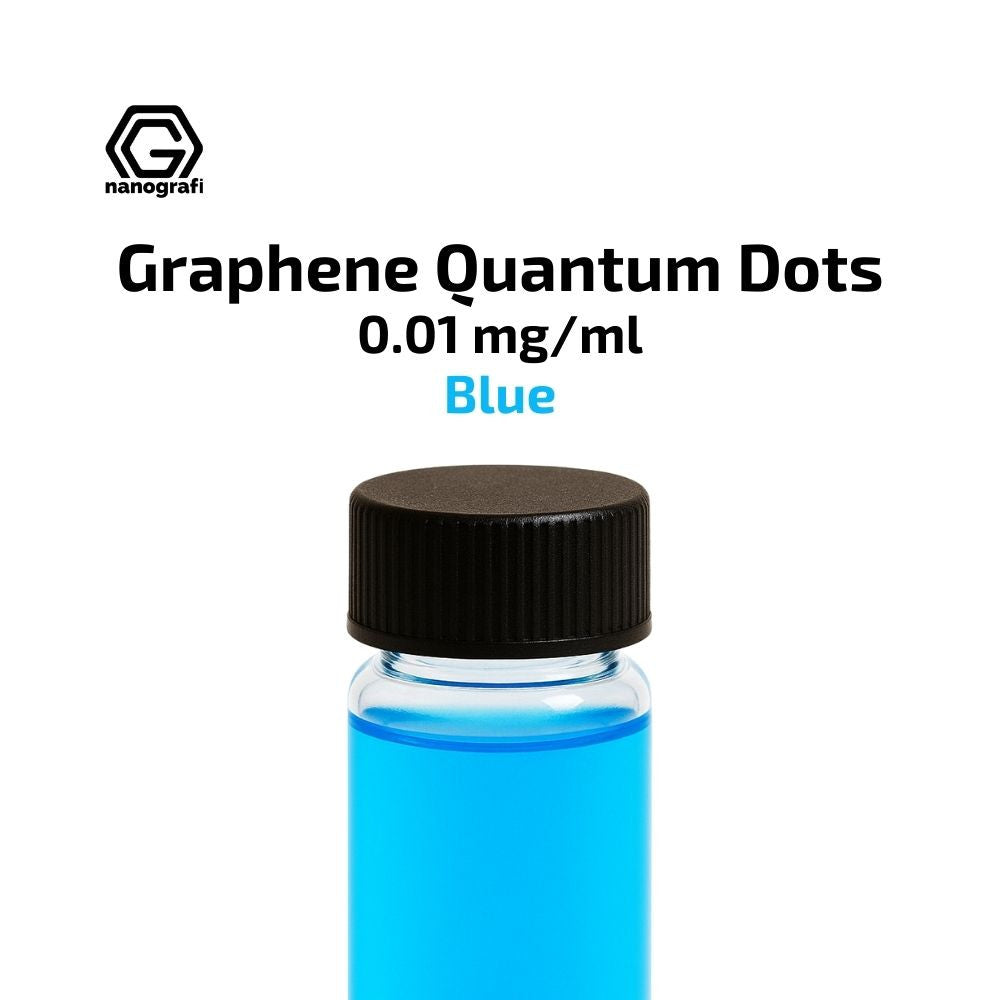
Blue Graphene Quantum Dots (GQDs) from Nanografi are supplied as a dispersion in DI water at a concentration of 0.01 mg/ml. The spherical dots have a diameter below 10 nm and emit blue light in the 445-470 nm range, making them a ready-to-use fluorescent nanomaterial for research labs.
GQDs are zero-dimensional nanocrystals derived from graphene semiconductors and keep graphene's characteristic honeycomb lattice. Their very small size, generally within 1-50 nm for this material class, gives them distinctive electronic and optical behaviour, which is why they attract interest across electronics, biomedicine, energy and materials science.
Each batch is characterised as standard by measuring excitation and emission wavelengths with a PL spectrophotometer. Particle size distribution, quantum yield and fluorescence lifetime can be analysed on request as additional services at extra cost.
- Optoelectronic research on LEDs, photodetectors and solar cells that exploits the strong, tunable photoluminescence of GQDs.
- Biomedical work such as bioimaging, biosensors, drug delivery systems and photodynamic therapy studies, supported by their biocompatibility and low toxicity.
- Sensitive chemical and biological sensors for detecting ions, molecules and biomolecules, including agricultural sensors for plant health and environmental stress.
- Energy storage and conversion studies aimed at improving conductivity and charge storage in lithium-ion batteries and supercapacitors, as well as fuel cells and photocatalysis.
- Environmental applications including water purification, pollutant detection and photocatalytic degradation of organic contaminants.
| Brand | Nanografi |
|---|---|
| CAS number | — |
| Molecular formula | — |
| Purity | — |
| Category | — |
| Pack sizes | 25 ml, 50 ml, 100 ml, 500 ml, 1000 ml |
| Physical form | — |
| Storage | — |
- Product code: NG10GNPW0925
- Diameter: <10 nm
- Morphology: Spherical
- Emission Wavelength Range: 445-470 nm
- Color: Blue
- Solvent: DI Water
- Concentration: 0.01 mg/ml
- Standard Analysis: Excitation and Emission wavelength with PL Spectrophotometer
—
—
