

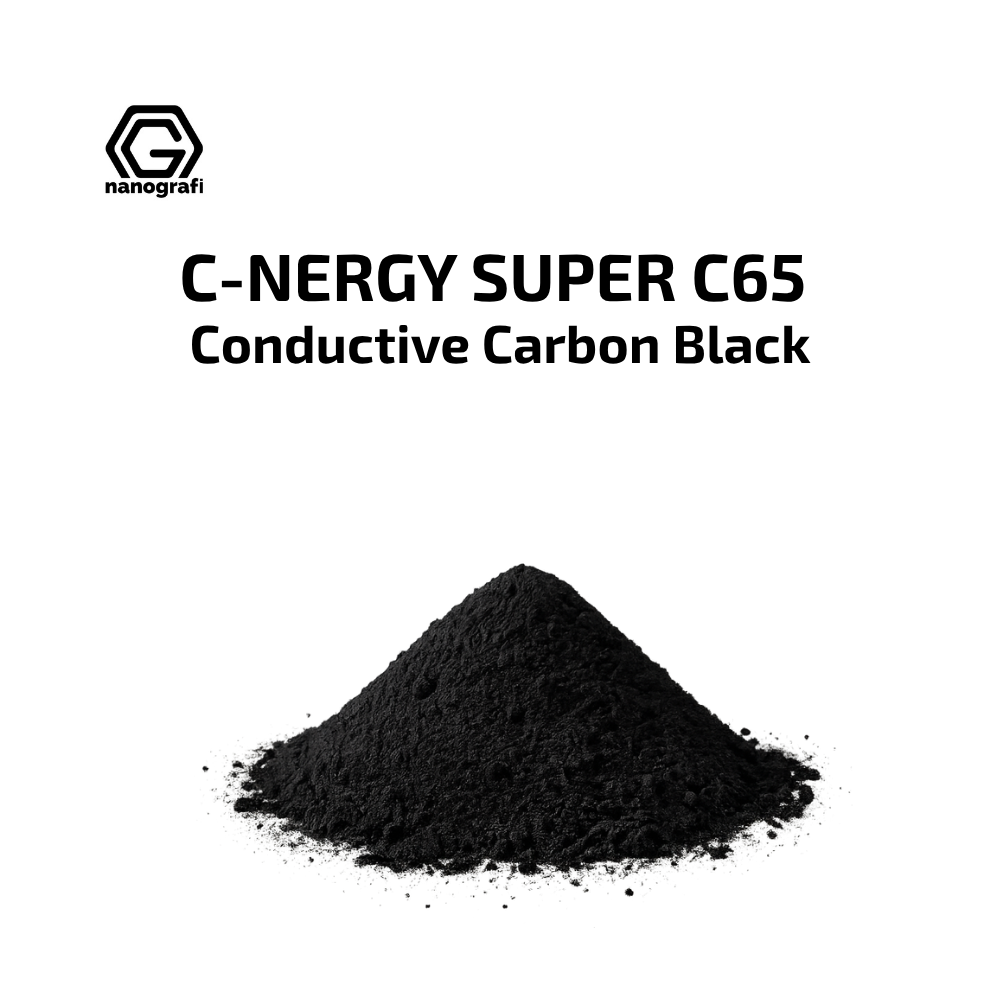
C-NERGY SUPER C65 from Nanografi is a high-purity conductive carbon black (CAS 1333-86-4) used as a conductive additive in lithium-ion battery electrodes and other electrochemical systems. It helps build electron pathways between active material particles and the current collector in both cathode and anode formulations.
The material pairs a high structure with a low surface area (BET 62 m²/g), which supports even distribution in electrode slurries and helps limit particle agglomeration. Its highly graphitic character gives good stability, low moisture pick-up and reduced chemical degradation, while low metal contamination and strict cleanliness suit demanding battery and electronics work.
Volatile content is max. 0.15% and ash content max. 0.025%, with a pH of 10. Actual performance depends on electrode composition, carbon loading, binder system, dispersion quality and processing conditions, so formulations should be optimized for each chemistry. Available in 100, 250, 500 and 1000 gram packs.
- Conductive additive in lithium-ion battery cathode and anode formulations, forming an electrical network at low loading.
- Electrode slurry preparation where uniform dispersion and reduced agglomeration are needed.
- Helping reduce the open circuit voltage (OCV) rejection rate during cell production.
- Electrical modifier for antistatic, static-dissipative or conductive plastics and composites.
- Conductive component in supercapacitor formulations to support charge carrier mobility and power density.
| Brand | Nanografi |
|---|---|
| CAS number | 1333-86-4 |
| Molecular formula | — |
| Purity | — |
| Category | — |
| Pack sizes | 100 grams, 250 grams, 500 grams, 1000 grams |
| Physical form | — |
| Storage | — |
- Product code: NG04CO08029
- Absorption Stiffness Value: 32 ml/5g
- BET Surface Area: 62 m²/g
- Volatile Content: Max. 0.15%
- Ash Content: Max. 0.025%
- pH: 10
- Product Code: NG04CO08029
Keep in a tightly sealed container in a clean, dry place to limit moisture uptake and contamination. Minimize airborne dust with containment, ventilation and personal protective equipment. Fine carbon powder can pose a combustible dust hazard, so avoid ignition sources and dust build-up, and consult the Safety Data Sheet before weighing, mixing or processing.
—