

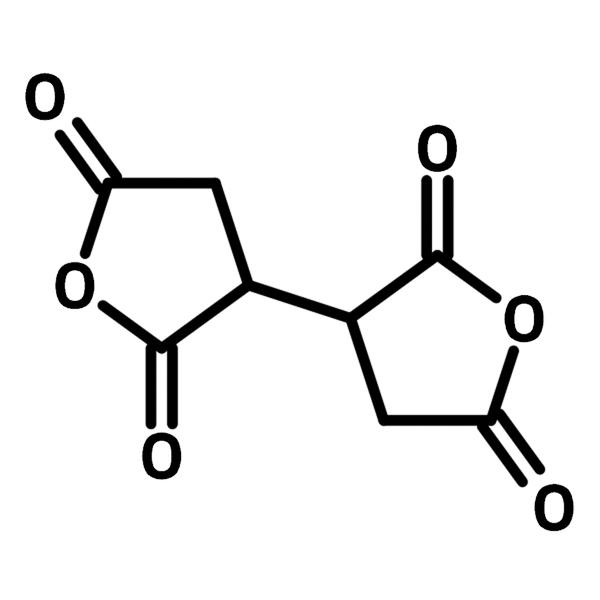
1,2,3,4-Butanetetracarboxylic dianhydride (BDA, CAS 4534-73-0) is a dianhydride building block made up of two succinic anhydride rings joined through a single carbon-carbon bond. Its anhydride end groups react readily with amines and hydroxyl groups, giving imides and esters, which makes it a useful intermediate for preparing polyimides and polyesters.
In textile chemistry, BDA is widely known as an anti-wrinkle agent for cotton: it crosslinks cellulose by esterification, and this modification also improves the breaking and tearing strength of the fabric. Combined with polysaccharides, it yields superabsorbent hydrogels used for water purification and for retaining water in agriculture.
Reacting BDA with diols produces ionomers with high ionic conductivity, candidates for solid polymer electrolytes. It also serves as a bisuccinic anhydride ligand for building crosslinked COF and MOF networks. Ossila supplies BDA at >99% purity as a white to pale yellow to slight brown powder or crystal.
- Synthesis of polyimides and polyesters through reactions with amines and hydroxyl groups.
- Anti-wrinkle crosslinking treatment of cotton fabrics that also improves breaking and tearing strength.
- Preparation of polysaccharide-based superabsorbent hydrogels for water purification and agricultural water retention.
- Preparation of highly ion-conductive ionomers from diols for solid polymer electrolytes.
- Ligand for crosslinked COF and MOF networks.
| Brand | Ossila |
|---|---|
| CAS number | 4534-73-0 |
| Molecular formula | C8H6O6 |
| Purity | >99% |
| Category | — |
| Pack sizes | 25 g, 50 g, 100 g |
| Physical form | White to pale yellow to slight brown powder/crystal |
| Storage | — |
- Product code: B2101
- Molecular Weight: 198.13 g/mol
- Synonyms: Tetrahydro(3,3'-bifuran)-2,2',5,5'-tetrone, 3-(2,5-Dioxooxolan-3-yl)oxolane-2,5-dione
- Melting Point: 242 °C – 243 °C
- Classification / Family: Dianhydride building block, Polyesters, Polyimides, Hydrogels, Absorbances
—
—