

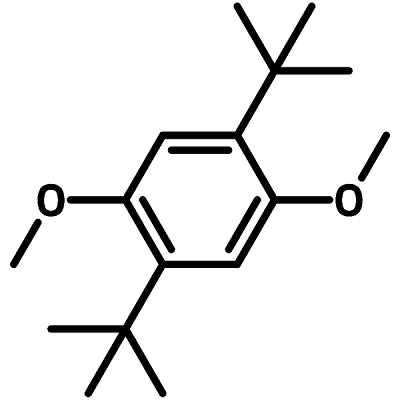
1,4-Di-tert-butyl-2,5-dimethoxybenzene, commonly called DDB (CAS 7323-63-9), is an aromatic redox shuttle molecule widely regarded as a reference compound for lithium ion battery (LIB) research. Its benzene ring carries two methoxy groups and two bulky tert-butyl groups, which give the molecule a rigid structure with excellent electrochemical reversibility and stability.
Added to the electrolyte, DDB guards LiFePO4-based Li-ion cells against overcharging through a stable, reversible redox reaction at 3.9 V vs. Li/Li+. In LiFePO4 cathode cells it has sustained more than 200 cycles of 100% overcharge per cycle at both C/2 and 1C rates, supporting high-rate overcharge protection studies.
Researchers should note that the symmetric structure of DDB gives it low polarity, which limits its solubility in carbonate electrolytes and leaves its redox potential too low for 4 V LIB operation. It is supplied as a white to off-white powder with >99% purity by GC.
- Redox shuttle additive for overcharge protection of lithium ion batteries.
- High-rate overcharge protection studies in LiFePO4-based Li-ion cells.
- Benchmark reference compound when developing and comparing new redox shuttle molecules.
- Core structure for research into polymeric cathode materials with intrinsic overcharge protection.
| Brand | Ossila |
|---|---|
| CAS number | 7323-63-9 |
| Molecular formula | C16H26O2 |
| Purity | >99% (GC) |
| Category | — |
| Pack sizes | 25 g, 100 g, 250 g, 500 g, 1 kg |
| Physical form | White to off-white powder |
| Storage | — |
- Product code: M2391B1
- Molecular Weight: 250.38 g/mol
- Synonyms: DDB, 2,5-Di-tert-butyl-1,4-dimethoxybenzene
- Melting Point: 103-104 °C
- Redox Potential: 3.9 V vs. Li/Li+
- Classification: Redox Shuttle, Battery materials, Energy materials, Lithium ion batteries
—
—