

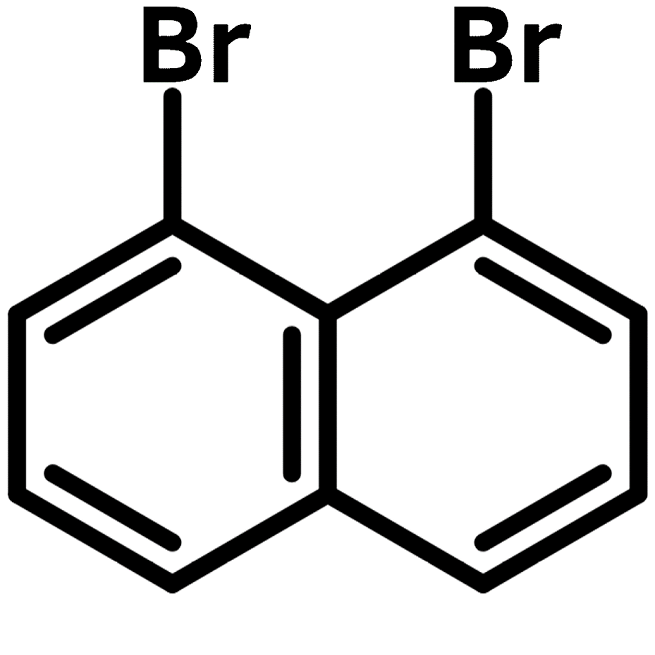
1,8-Dibromonaphthalene (1,8-DBN, CAS 17135-74-9) is a naphthalene intermediate carrying two bromine atoms at the 1 and 8 (peri) positions, placed symmetrically opposite each other across the carbons that join the two rings. Supplied at >98% purity (1H NMR), it serves as a starting material for the synthesis of OLED and organic photovoltaic materials.
Its main role is as a precursor to 1,8-diarylnaphthalenes, a class of strained organic molecules in which two peri-aryl rings sit close together, face to face and in parallel, nearly perpendicular to the central naphthalene core. This unusual geometry makes these compounds of interest for blue and green photoluminescent OLEDs, chiral ligands and sensors, nonlinear optical chromophores and stereodynamic switches.
The material appears as a powder or crystals ranging from white to yellow, pale beige to beige, or pale brown to brown, with a melting point of 110 °C.
- Synthesis of 1,8-diarylnaphthalenes as strained organic molecules.
- Preparation of materials for highly efficient blue and green photoluminescent OLEDs.
- Building block for organic photovoltaic and other optoelectronic materials.
- Development of chiral ligands and photoluminescent sensors.
- Research on nonlinear optical chromophores and stereodynamic switches.
| Brand | Ossila |
|---|---|
| CAS number | 17135-74-9 |
| Molecular formula | C10H6Br2 |
| Purity | >98% (1H NMR) |
| Category | — |
| Pack sizes | 10 g, 25 g, 50 g |
| Physical form | White to Yellow, Pale Beige to Beige, Pale Brown to Brown powder/crystals |
| Storage | — |
- Product code: B1271
- Full Name: 1,8-Dibromonaphthalene
- Molecular Weight: 285.97 g/mol
- Synonyms: 1,8-DBN
- Classification / Family: Naphthalenes, Semiconductor synthesis intermediates, Low band gap polymers, OLED, OFETs, organic photovoltaics
- Melting Point: 110 °C
—
—