

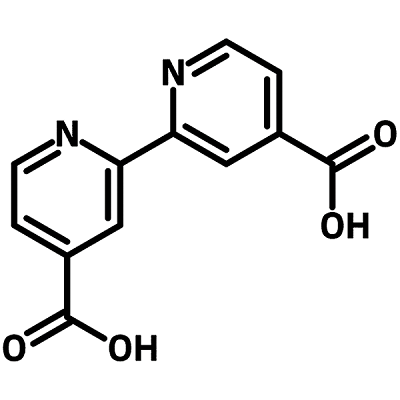
2,2′-Bipyridine-4,4′-dicarboxylic acid (dcbpy, CAS 6813-38-3) is a bipyridyl ligand carrying two electron-withdrawing carboxylic acid groups at the 4,4′-positions. It is widely used to build organometallic photosensitizer dyes for dye-sensitized solar cells (DSSCs), and also serves as a ligand for cross-linked MOF and COF networks, where the acid groups coordinate to metal centres.
In a DSSC, the two carboxylic groups bind chemically to nanocrystalline TiO2 films through ester-like linkages, strengthening dye adsorption and electronic coupling with the semiconductor surface. After light absorption, the excited state sits in a LUMO localised on this anchoring ligand, with conjugation reaching from the pyridine rings into the anchor, so charge can be injected efficiently into the film.
This ligand is a building block of established sensitizers such as N3, N719, Z907 and K19, for which light-to-electricity conversion efficiencies above 10% have been reported under AM 1.5 irradiation. Ossila supplies it as a white powder with >98% purity determined by 1H NMR.
- Synthesis of organometallic photosensitizer dyes for dye-sensitized solar cells.
- Preparation of ruthenium sensitizers such as N3, N719, Z907 and K19.
- Gap-filling self-assembled monolayers or electron-selective contacts in solar cell research.
- Ligand for constructing cross-linked MOF and COF networks.
| Brand | Ossila |
|---|---|
| CAS number | 6813-38-3 |
| Molecular formula | C12H8N2O4 |
| Purity | >98% (1H NMR) |
| Category | — |
| Pack sizes | 5 g, 10 g, 25 g |
| Physical form | White powder |
| Storage | — |
- Product code: B1391
- Molecular Weight: 244.20 g/mol
- Synonyms: Dcbpy, 2,2′-Bipyridyl-4,4′-dicarboxylic acid
- Melting Point: >250 °C
- Classification / Family: Bipyridyl derivatives, Semiconductor synthesis intermediates, Dye-sensitized solar cells (DSSCs)
—
—