

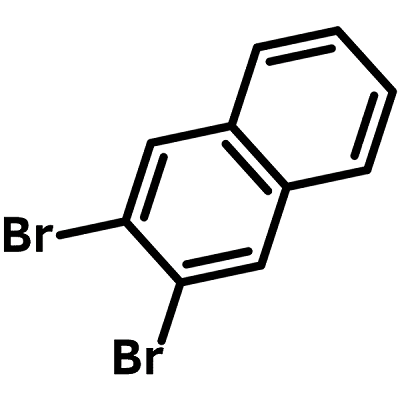
2,3-Dibromonaphthalene (2,3-DBN, CAS 13214-70-5) is a dibromonaphthalene isomer in which the two bromine substituents sit on adjacent positions of the naphthalene ring. The bromide end groups make it a convenient partner in coupling reactions, so it serves as an intermediate for building larger polycyclic aromatic hydrocarbons and materials for organic photovoltaics, OLEDs, OFETs and low band gap polymers.
X-ray diffraction studies reveal an ordered crystal in which weak, directional interactions arrange the molecules in a herringbone packing. This makes 2,3-DBN a useful host matrix for fluorescent polycyclic aromatic hydrocarbon (PAH) guests; for example, single terrylene molecules embedded in the host also adopt a herringbone arrangement guided by the 2,3-DBN lattice.
The material is supplied as a white to off-white powder or crystals with a purity above 98% determined by 1H NMR, and a melting point of 142 °C.
- Building block for the synthesis of polycyclic aromatic hydrocarbons via coupling reactions.
- Intermediate for organic photovoltaic, OLED and OFET materials.
- Precursor in the synthesis of low band gap polymers and semiconductor materials.
- Crystalline host matrix for single fluorescent PAH molecules such as terrylene.
| Brand | Ossila |
|---|---|
| CAS number | 13214-70-5 |
| Molecular formula | C10H6Br2 |
| Purity | >98% (1H NMR) |
| Category | — |
| Pack sizes | 1 g, 5 g, 10 g, 25 g |
| Physical form | White to off-white powder/crystals |
| Storage | — |
- Product code: B1251
- Molecular Weight: 285.97 g/mol
- Synonyms: 2,3-DBN
- Melting Point: 142 °C
- Classification / Family: Naphthalenes, Semiconductor synthesis intermediates, Low band gap polymers, OLED, OFETs, organic photovoltaics
—
—