

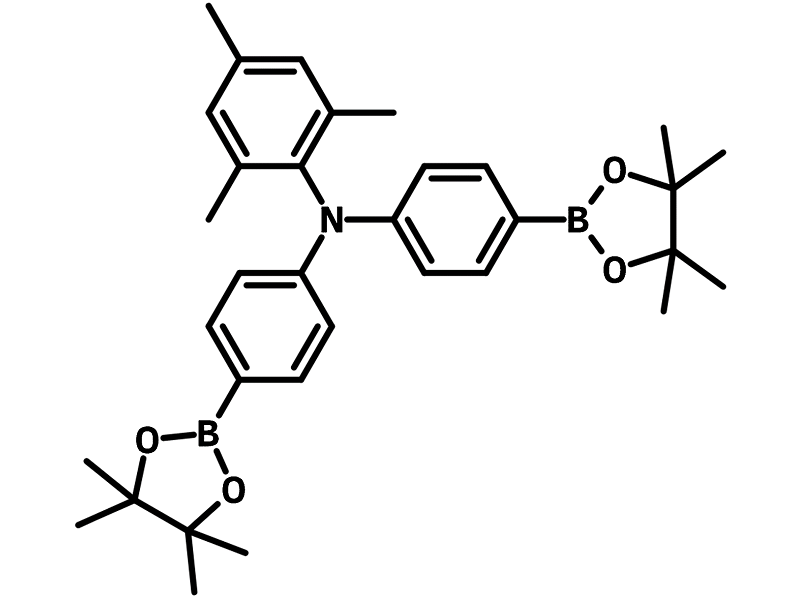
2,4,6-Trimethyl-N,N-bis(4-(4,4,5,5-tetramethyl-1,3,2-dioxaborolan-2-yl)phenyl)aniline (CAS 1282616-14-1) is a triphenylamine derivative carrying two pinacol boronic ester groups. It serves as a building block for preparing hole transport small molecules and polymers used in organic light-emitting devices (OLEDs), organic photovoltaics and perovskite solar cells.
One of its three aryl rings is a trimethylphenyl group, which adds a little extra steric bulk and helps the resulting molecules dissolve more readily in organic solvents. With a boronic ester at each end, the intermediate can be extended into larger structures or polymers through C-C bond-forming chemistry such as Suzuki cross coupling.
The compound can be made by reacting bis(pinacolato)diboron with N,N-Bis(4-bromophenyl)-2,4,6-trimethylaniline. It is supplied at >98% purity (1H NMR) as a white to light yellow powder or crystals, in 1 g, 2 g, 5 g and 10 g packs.
- Suzuki cross coupling to build triarylamine-based small molecules.
- Suzuki polycondensation to prepare polytriarylamine hole transport polymers.
- Synthesis of hole transport layer materials for perovskite solar cells.
- Preparation of semiconducting materials for OLEDs and organic photovoltaics.
| Brand | Ossila |
|---|---|
| CAS number | 1282616-14-1 |
| Molecular formula | C33H43B2NO4 |
| Purity | >98% (1H NMR) |
| Category | — |
| Pack sizes | 1 g, 2 g, 5 g, 10 g |
| Physical form | White to light yellow powder/crystals |
| Storage | — |
- Product code: B1801
- Molecular Weight: 539.32 g/mol
- Synonyms: Benzenamine, 2,4,6-trimethyl-N,N-bis[4-(4,4,5,5-tetramethyl-1,3,2-dioxaborolan-2-yl)phenyl]-
- Classification / Family: Triphenylamine derivatives, Semiconductor synthesis intermediates, Hole transport layer, Perovskite solar cells
—
—