

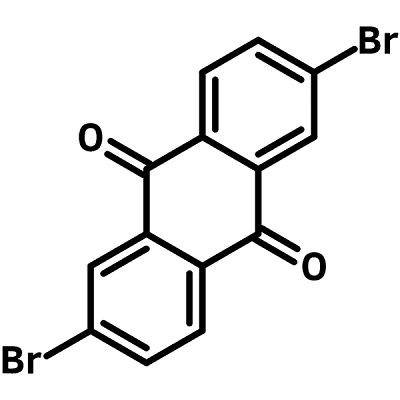
2,6-Dibromoanthraquinone (2,6-DBAQ, CAS 633-70-5) from Ossila is an electron-poor anthraquinone intermediate used to build semiconducting small molecules and polymers. Its anthracene-9,10-dione core carries bromine atoms at the 2 and 6 positions, giving two reactive handles for cross-coupling, while the dione groups offer further routes to extend conjugation. Supplied as a yellow/brown powder with >96% purity by 1H NMR.
Researchers use this compound to make fluorophores, photocatalysts, OLED emitters and organic photovoltaic materials. In one reported example, coupling it with 1,1,2,2-tetrakis(4-ethynylphenyl)ethene gave the conjugated organic polymer AQTEE-COP, which generated H2O2 photocatalytically at an initial rate of 3204 μmol g-1 h-1 under visible light (λ ≥ 400 nm) with no added photosensitizer, scavenger or co-catalyst.
It has also served as the precursor to the strong acceptor 2,2′-(anthracene-9,10-diylidene) dimalononitrile, used in NIR-II AIE fluorophores (AQMN) that, once encapsulated in nanoparticles, enabled high-resolution mouse ear vessel imaging. Published work further covers anthraquinone-based microporous polymer cathodes for lithium-ion batteries and anthracene materials for field-effect transistors.
- Synthesis of semiconducting small molecules and polymers for OLEDs.
- Preparation of materials for organic solar cells and organic photovoltaics.
- Construction of conjugated polymers for photocatalytic hydrogen peroxide production.
- Development of NIR-II fluorophores for biological imaging.
- Synthesis of anthraquinone-based conjugated microporous polymer cathodes for lithium-ion batteries.
- Preparation of anthracene derivatives for organic field-effect transistors.
| Brand | Ossila |
|---|---|
| CAS number | 633-70-5 |
| Molecular formula | C14H6Br2O2 |
| Purity | >96% (1H NMR) |
| Category | — |
| Pack sizes | 5 g, 10 g, 25 g, 50 g |
| Physical form | Yellow/brown powder |
| Storage | — |
- Product code: B1461
- Molecular Weight: 366.01 g/mol
- Synonyms: 2,6-DBAQ, 2,6-Dibromoxyanthracene-9,10-dione
- Classification / Family: Anthraquinone derivatives, Dyes, Semiconductor synthesis intermediates, OLED, OFETs, organic photovoltaics
- Melting Point: Tm = 290 °C (lit.)
—
—