

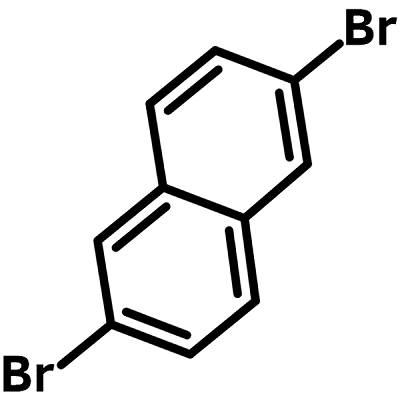
2,6-Dibromonaphthalene (2,6-DBN, CAS 13720-06-4) is a naphthalene ring carrying two bromine atoms, supplied at >98% purity (1H NMR) as an intermediate for organic electronics research. The bromide end groups make it well suited to coupling reactions, so it serves as a starting block for small semiconducting molecules and polymers used in OPVs, OLEDs and OFETs.
Published work shows what it can lead to. Single crystals of 2,6-di(anthracen-2-yl)naphthalene made from this compound gave bright yellowish-green emission, balanced ambipolar transport, charge mobility of up to 19 cm2 V-1 and an absolute fluorescence quantum yield of 37.09%. The wide-bandgap (Ebg = 3.35 eV) semiconductor BOPNA delivered a hole mobility of ~1 cm2 V-1 in transistors that are fully transparent in the visible range (>370 nm).
Its naphthalene core also appears in Phen-NaDPO, a cathode interlayer with a Tg of 116 °C that lowers the work function of Ag and ITO and improves electron extraction and PCE in OPV devices. Further uses include non-fullerene acceptors and hole-transporting hosts for OLEDs.
- Synthesis of small-molecule and polymer semiconductors for organic thin-film and field-effect transistors.
- Preparation of cathode interfacial materials for organic photovoltaic devices.
- Building non-fullerene acceptors for organic solar cells.
- Construction of hole-transporting host materials for OLEDs.
- Coupling reactions that exploit its two bromide end groups.
| Brand | Ossila |
|---|---|
| CAS number | 13720-06-4 |
| Molecular formula | C10H6Br2 |
| Purity | >98% (1H NMR) |
| Category | — |
| Pack sizes | 5 g, 10 g, 25 g |
| Physical form | White to yellow, pale beige to beige, pale brown to brown powder/crystals |
| Storage | — |
- Product code: B1321
- Molecular Weight: 285.97 g/mol
- Synonyms: 2,6-DBN
- Melting Point: Tm = 162 °C
- Classification / Family: Naphthalenes, Semiconductor synthesis intermediates, Low band gap polymers, OLED, OFETs, organic photovoltaics
—
—