

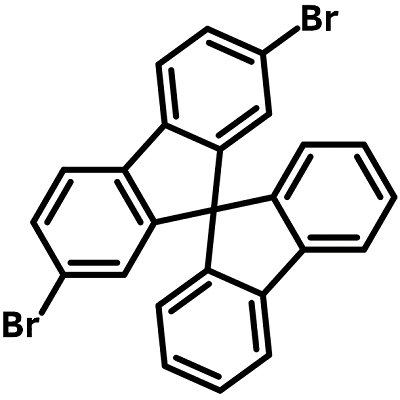
2,7-Dibromo-9,9′-spirobifluorene (DBSBF, CAS 171408-84-7) is a synthesis intermediate for building semiconducting small molecules and polymers with a spirobifluorene core. These materials are used in high-efficiency OLEDs, perovskite solar cells and other organic electronic devices. The compound carries two bromine atoms at the 2,7-positions of one of the two linked fluorene units, and is supplied at >99% purity (HPLC) as a white to off-white powder or crystals.
The bromide end groups make the molecule well suited to coupling reactions, so derivatives with different electronic and physical properties can be prepared. The spiro-linked sp3 carbon at the 9-position interrupts conjugation, which raises triplet energy, while the twisted, non-coplanar geometry prevents tight molecular packing. This favours amorphous glassy films with good morphological stability, a higher glass transition temperature and thermal and chemical robustness, and leaves space for further substitution at the 2,7-positions.
Well-known spirobifluorene materials include the hole transport material Spiro-NPB and the electron transport material SPPO13. DBSBF itself can be made by reacting 2,7-dibromo-9-fluorenone with the Grignard reagent of 2-bromobiphenyl.
- Synthesis of spirobifluorene-based host, emitter and charge transport materials for OLEDs.
- Preparation of semiconducting molecules and polymers for perovskite solar cells and organic photovoltaics.
- Building block for low band gap polymers and OFET materials.
- Starting material for coupling reactions to create derivatives with tailored electronic properties.
| Brand | Ossila |
|---|---|
| CAS number | 171408-84-7 |
| Molecular formula | C25H14Br2 |
| Purity | >99% (HPLC) |
| Category | — |
| Pack sizes | 10 g, 25 g, 50 g, 100 g |
| Physical form | White to off-white powder/crystals |
| Storage | — |
- Product code: B1001
- Molecular Weight: 474.19 g/mol
- Synonyms: 2,7-Dibromo-9,9′-spirobi[9H-fluorene], DBSBF
- Melting Point: 334 °C - 336 °C
- Classification / Family: Spirobifluorene, semiconductor synthesis intermediates, low band gap polymers, OLED, OFETs, organic photovoltaics
—
—