

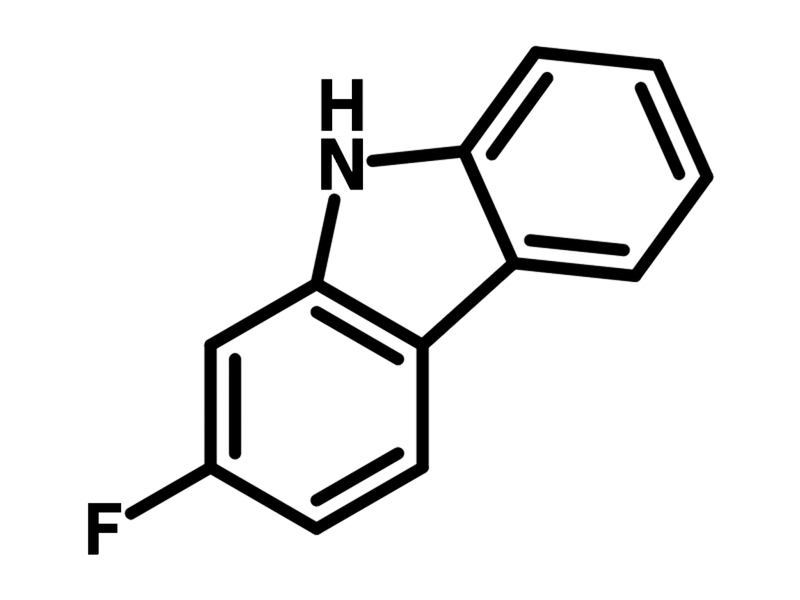
2-Fluoro-9H-carbazole (CAS 391-53-7), also known as 2-fluorocarbazole, is a fluorinated heterocyclic building block based on the carbazole core: two benzene rings joined through a central pyrrole ring. It is supplied as an off-white powder with a purity above 99% and serves as an intermediate in drug discovery, organic synthesis and OLED materials research.
The compound and its derivatives have shown antibacterial activity, with a minimum inhibitory concentration of 25 µg/mL against E. coli, B. subtilis and S. aureus. Its N-H position allows coupling to other halogenated building blocks through Buchwald-Hartwig amination or copper-catalysed alkylation, a route used to extend the chromophore of the resulting molecules.
In organic electronics, a fluorinated polyvinylcarbazole prepared from 2-fluoro-9H-carbazole has been used as a host material in OLEDs. Thanks to the wider HOMO-LUMO gap of the fluorinated polymer, devices reached a luminous current efficiency of 24 cd/A, compared with 17 cd/A for standard polyvinylcarbazole.
- Intermediate for synthesising carbazole derivatives with antibacterial activity.
- Building block in drug discovery and active pharmaceutical ingredient research.
- Precursor for fluorinated polyvinylcarbazole host materials in OLEDs.
- Coupling partner in Buchwald-Hartwig amination and copper-catalysed alkylation to enlarge chromophores.
- Starting material for emitter molecules in luminescence research.
| Brand | Ossila |
|---|---|
| CAS number | 391-53-7 |
| Molecular formula | C12H8FN |
| Purity | >99% |
| Category | — |
| Pack sizes | 1 g, 2 g |
| Physical form | Off-white powder |
| Storage | — |
- Product code: B1591
- Molecular Weight: 185.20 g/mol
- Synonyms: 2-Fluorocarbazole
- Classification / Family: Fluorinated building block, Heterocyclic building block, OLEDs, APIs
- Melting Point: 227 °C
—
—