

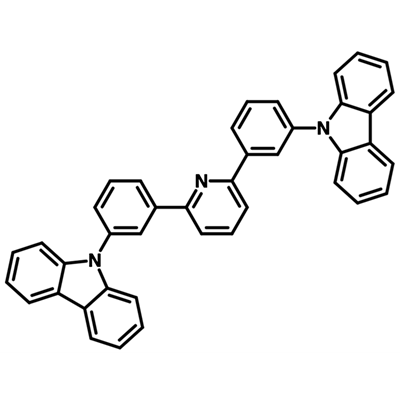
26DCzPPy, or 2,6-bis(3-(carbazol-9-yl)phenyl)pyridine (CAS 1013405-24-7), is a widely used bipolar host material for organic light-emitting diodes (OLEDs). It is supplied as a white powder or crystals in both sublimed and unsublimed grades, each with purity above 99%.
The molecule pairs carbazole donor units, which bring a high triplet energy, with a pyridine acceptor of high electron affinity. In a bipolar host, the electron-donating part supports hole injection and transport, while the electron-withdrawing part supports electron injection and transport, giving balanced charge handling within the emissive layer.
26DCzPPy has a HOMO of 6.05 eV and a LUMO of 2.56 eV, and shows thermal stability with TGA above 370 °C (0.5% weight loss). Published device work has used it as a host for blue, green, red and white phosphorescent emitters, including FIrpic-based blue and white OLEDs.
- Host material for phosphorescent emitters such as FIrpic in blue OLEDs.
- Host in double emitting layer structures for white phosphorescent OLEDs.
- Host for green emitters such as Ir(mppy)3 in solution-processed OLED devices.
- Host for red platinum(II) Schiff base emitters in electroluminescent devices.
- Bipolar charge transport layer material in organic electronics research.
| Brand | Ossila |
|---|---|
| CAS number | 1013405-24-7 |
| Molecular formula | C41H27N3 |
| Purity | Sublimed grade >99%, Unsublimed grade >99% |
| Category | — |
| Pack sizes | 250 mg, 500 mg, 1 g |
| Physical form | White powder/crystals |
| Storage | — |
- Product code: M0771A1
- Molecular weight: 561.67 g/mol
- Thermal stability: TGA > 370 °C (0.5% weight loss)
- Absorption: λmax 239, 292 nm (in CH2Cl2)
- Fluorescence: λem 410 nm (in CH2Cl2)
- HOMO/LUMO: HOMO = 6.05 eV, LUMO = 2.56 eV
- Synonyms: 2,6-bis[3-(9H-Carbazol-9-yl)phenyl]pyridine; DCzPPy
- Classification: Carbazole derivatives, Bipolar charge transport layer materials, Phosphorescent host materials, OLEDs, Organic electronics
—
—