

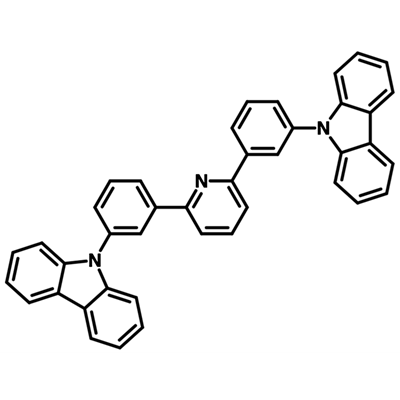
26DCzPPy, or 2,6-bis(3-(carbazol-9-yl)phenyl)pyridine (CAS 1013405-24-7), is a widely used bipolar host for organic light-emitting diodes. Its structure pairs carbazole donor units, which bring a high triplet energy, with a pyridine acceptor that offers high electron affinity.
Because it contains both an electron-donating part that supports hole injection and transport and an electron-withdrawing part that supports electron injection and transport, 26DCzPPy can carry both types of charge within the emissive layer. It belongs to the carbazole derivative family and is used as a phosphorescent host and bipolar charge transport layer material.
The material is a white powder or crystalline solid with HOMO and LUMO levels of 6.05 eV and 2.56 eV. Reported devices built with it include blue, green, red and white phosphorescent OLEDs, often with FIrpic as the blue dopant. It is offered in sublimed and unsublimed grades, each with purity above 99%.
- Host matrix for blue phosphorescent OLED emitters such as FIrpic.
- Host layers in white OLEDs that combine several phosphorescent dopants.
- Host for green and red phosphorescent emitters in OLED stacks.
- Bipolar charge transport layer material in organic electronic devices.
- Research on solution-processed and blade-coated small-molecule OLEDs.
| Brand | Ossila |
|---|---|
| CAS number | 1013405-24-7 |
| Molecular formula | C41H27N3 |
| Purity | Sublimed grade >99%, Unsublimed grade >99% |
| Category | — |
| Pack sizes | — |
| Physical form | White powder/crystals |
| Storage | — |
- Product code: M772
- Molecular weight: 561.67 g/mol
- Absorption: λmax 239, 292 nm (in CH2Cl2)
- Fluorescence: λem 410 nm (in CH2Cl2)
- HOMO/LUMO: HOMO = 6.05 eV, LUMO = 2.56 eV
- Synonyms: 2,6-bis[3-(9H-Carbazol-9-yl)phenyl]pyridine; DCzPPy
- Thermal stability: TGA > 370 °C (0.5% weight loss)
- Classification: Carbazole derivatives, Bipolar charge transport layer materials, Phosphorescent host materials, OLEDs, Organic electronics
—
—