

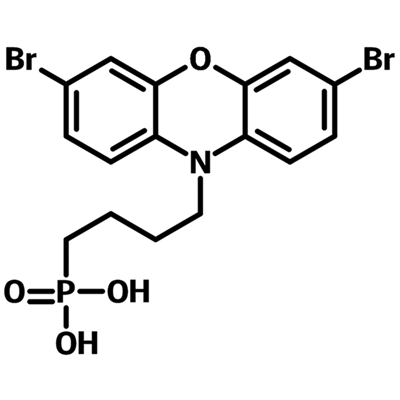
2BrPXZPA, also known as Br-4BPO, is a self-assembled monolayer (SAM) molecule designed to act as a hole transport or hole extraction layer in p-i-n perovskite solar cells and non-fullerene acceptor (NFA) polymer solar cells. Its structure combines an electron-donating 3,7-dibromo-10H-phenoxazine head group, an n-butyl chain and a phosphonic acid anchoring group.
Phenoxazine can be viewed as a carbazole with an oxygen atom introduced, and this oxygen coordinates more strongly with lead than sulfur does. The bromine substituents help tune band alignment between the SAM and the perovskite absorber while also coordinating exposed Pb 2+ at the interface. Used as the hole selective contact in an ITO/2BrPXZPA/Cs 0.05 (FA 0.85 MA 0.15 ) 0.95 Pb(I 0.85 Br 0.15 ) 3 /PC61BM/BCP/Ag device, it delivered a PCE of 22.93%, keeping 97% of its initial efficiency after 600 hours of light soaking under AM 1.5G. Applied on a NiO x hole selective layer, it raised PCE to 23.66% from 20.55% for the control.
The material offers an alternative to PEDOT:PSS and can be deposited from solution at a low concentration of 1 mM. It is supplied as a blue powder or crystals with a purity above 98% (HPLC).
- Hole selective contact in p-i-n (inverted) perovskite solar cells.
- Hole transport or extraction layer in NFA-polymer organic solar cells.
- Interface modification of NiO x hole selective layers to improve device efficiency.
- Solution-processed replacement for PEDOT:PSS in photovoltaic device stacks.
| Brand | Ossila |
|---|---|
| CAS number | N/A |
| Molecular formula | C16H16Br2NO4P |
| Purity | > 98% (HPLC) |
| Category | — |
| Pack sizes | 250 mg, 500 mg, 1 g |
| Physical form | Blue powder/crystals |
| Storage | — |
- Product code: M2458A1
- Molecular Weight: 477.08 g/mol
- Absorption: λ max 334 nm in THF, 342 nm in film
- HOMO/LUMO: HOMO = 5.46 eV, LUMO = 2.43 eV
- Melting Point: Td = 225 °C
- Synonyms: Br-4BPO, (4-(3,7-dibromo-10H-phenoxazin-10-yl)butyl)phosphonic acid
- Typical Solvents: THF, ethanol, methanol, IPA, DMF
- Typical Concentration: 1 mM (0.477 mg/ml) or 1.0 mg/ml
A typical deposition uses 30 uL of a 1.0 mg/ml solution in THF, spin-coated on the substrate centre for 30 s at 3000 rpm and then annealed for 10 min at 100 °C. Other typical solvents are ethanol, methanol, IPA and DMF. Refer to the MSDS for safety information.
—