

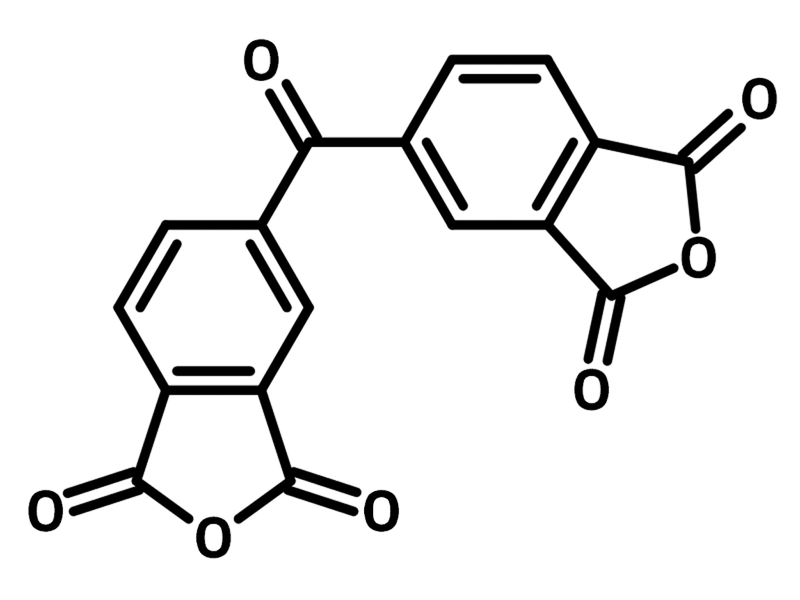
3,3',4,4'-Benzophenonetetracarboxylic dianhydride (BTDA, CAS 2421-28-5) is a monomer built on a benzophenone core, with an anhydride group at each end of the molecule. Supplied by Ossila at >98.5% purity as a white to off-white powder, it serves mainly as an intermediate for making polyimides.
Polyimides form when BTDA reacts with primary amines through nucleophilic substitution and subsequent condensation. Polymers and copolymers made from BTDA combine high thermal stability with good mechanical properties. Because these polyimides behave as electrets, they can act as the dielectric layer in high-performance organic field-effect transistor (OFET) memory devices.
Benzophenone-cored polyimides are also used to break down dyes such as methylene blue in water by photocatalysis, and may open routes to dye-sensitized solar cells (DSSCs) and other photocatalytic reactions. The compound is additionally a benzophenone building block for OLED and organic photovoltaic materials.
- Synthesis of polyimides by reaction with primary amines.
- Preparation of polyimide electret dielectric layers for OFET memory devices.
- Photocatalytic degradation of dyes such as methylene blue in water.
- Building block for OLED and organic photovoltaic materials.
- Exploratory work on dye-sensitized solar cells and photocatalytic reactions.
| Brand | Ossila |
|---|---|
| CAS number | 2421-28-5 |
| Molecular formula | C17H6O7 |
| Purity | >98.5% |
| Category | — |
| Pack sizes | 100 g, 200 g, 500 g |
| Physical form | White to off-white powder |
| Storage | — |
- Product code: B1931
- Molecular Weight: 322.23 g/mol
- Melting Point: 218 °C – 222 °C
- Synonyms: Benzophenone-3,3′,4,4′-tetracarboxylic dianhydride; 4,4′-Carbonyldiphthalic anhydride; BTDA
- Classification / Family: Benzophenone derivatives, Dianhydride building blocks, Polyimides, OFETs, Photosensitizers
—
—