

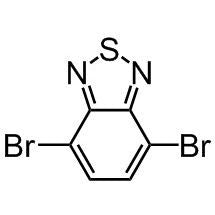
4,7-Dibromo-2,1,3-benzothiadiazole (CAS 15155-41-6) from Ossila is a bromine-capped benzothiadiazole building block used to make organic semiconductors for light-emitting diodes, photovoltaic devices and OFETs. It is supplied as light yellow crystals with a purity of ≥98% and a melting point of 187 °C - 190 °C.
The compound serves as a key intermediate for low band gap polymers. Brominating it further gives 4,7-bis(5-bromothiophen-2-yl)benzo[c][1,2,5]thiadiazole, a red monomer that leads to the polymer PCDTBT used in organic photovoltaic devices. It is also a starting point for PCPDTBT, a promising material for polymer solar cells.
The material itself is prepared by reacting 2,1,3-benzothiadiazole with bromine in hydrobromic acid. Its identity is characterised by 1H NMR spectroscopy in CDCl3, and it is also known as Dibromo Benzothiadiazole or Dibromo-BT.
- Monomer for synthesising organic semiconductors used in light-emitting diodes.
- Intermediate in the preparation of the PCDTBT polymer for organic photovoltaic devices.
- Starting material for PCPDTBT, a candidate polymer for polymer solar cells.
- Acceptor building block for low band gap conjugated polymers in OFET research.
| Brand | Ossila |
|---|---|
| CAS number | 15155-41-6 |
| Molecular formula | C6H2Br2N2S |
| Purity | ≥98% |
| Category | — |
| Pack sizes | 5 g, 10 g |
| Physical form | Light yellow crystals |
| Storage | — |
- Product code: B101
- Molecular Weight: 293.97 g/mol
- Melting Point: 187 °C - 190 °C
- Synonyms: Dibromo Benzothiadiazole, Dibromo-BT
- Product Code: B101
—
—