

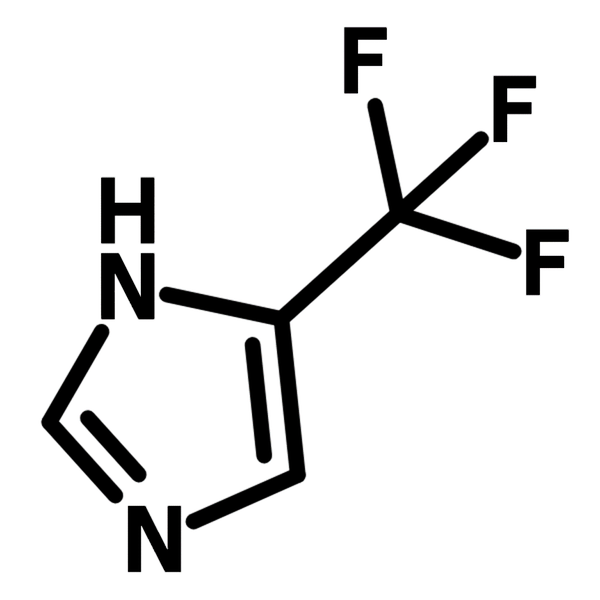
4-(Trifluoromethyl)-1H-imidazole (CAS 33468-69-8) is a fluorinated heterocyclic building block supplied by Ossila as an off-white to pale beige powder with 98% purity. It consists of a five-membered imidazole ring carrying two non-adjacent nitrogen atoms and a trifluoromethyl substituent, and serves as an intermediate for preparing ligands used in covalent organic frameworks (COFs), active pharmaceutical ingredients (APIs) and dye-sensitised solar cells (DSSCs).
The imidazolyl unit occurs in many biological molecules, such as histidine, which gives imidazole derivatives strong interactions with living systems; they are widely found in antimicrobial compounds, including the fungicide prochloraz and the herbicide imazamox. This makes the compound a useful starting point in drug discovery work.
For ligand design, the molecule lends itself to core expansion. Its reactive N-H (amine) group is readily modified through nucleophilic substitution, or it can be protected with chloromethyl methyl ether (MOMCl) so that subsequent substitutions are directed onto the ring carbons. Imidazole-based, nitrogen-rich COFs built with cyanuric chloride have been reported to capture CO2 (80.1 mL/g at 273K and 1 bar) and to catalyse the cycloaddition of CO2 with epoxides.
- Synthesis of coordinating ligands through core expansion of the imidazole ring.
- Preparation of nitrogen-rich covalent organic frameworks for CO2 capture and fixation.
- Building block for active pharmaceutical ingredients and antibacterial drug discovery research.
- Intermediate for imidazole-based ligands in dye-sensitised solar cells (DSSCs).
| Brand | Ossila |
|---|---|
| CAS number | 33468-69-8 |
| Molecular formula | C4H3F3N2 |
| Purity | 98% |
| Category | — |
| Pack sizes | 5 g, 10 g |
| Physical form | Off-white to pale beige powder |
| Storage | — |
- Product code: B1671
- Molecular Weight: 136.08 g/mol
- Synonyms: 5-(Trifluoromethyl)-1H-imidazole, 4-(Trifluoromethyl)imidazole
- Classification / Family: Fluorinated building block, Heterocyclic building block, COFs, APIs, DSSCs
- Melting Point: 148 °C – 150 °C
—
—