

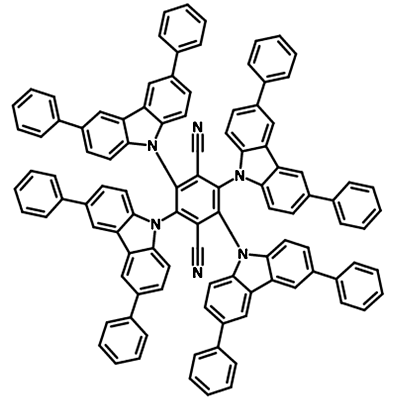
4CzTPN-Ph, or 2,3,5,6-tetrakis(3,6-diphenylcarbazol-9-yl)-1,4-dicyanobenzene (CAS 1416881-55-4), is an established orange emitter for thermally activated delayed fluorescence (TADF) OLEDs. It is supplied as an orange powder or crystals in unsublimed (>98%) and sublimed (>99.0%, HPLC) grades.
Relative to 4CzTPN, this molecule carries eight extra phenyl groups on the 3,6-positions of its carbazole units. These substituents strengthen its electron-donating character and add steric bulk, which helps suppress intermolecular interactions such as excimer formation.
Its donor-acceptor design also gives useful emission properties beyond displays. Dispersed in water as nanoparticles, 4CzTPN-Ph has been applied to one- and two-photon cellular fluorescence imaging, offering good dispersibility, strong resistance to photodegradation and photobleaching, and low cytotoxicity.
- Orange dopant in the emissive layer of high-efficiency TADF-OLED devices.
- Red/orange emitting component in white OLEDs combined with blue or green emitters.
- Nanoparticle probe for one-photon cellular fluorescence imaging.
- Nanoparticle probe for two-photon cellular fluorescence imaging.
| Brand | Ossila |
|---|---|
| CAS number | 1416881-55-4 |
| Molecular formula | C104H64N6 |
| Purity | Unsublimed >98%; Sublimed >99.0% (HPLC) |
| Category | — |
| Pack sizes | 100 mg, 250 mg, 500 mg, 1 g |
| Physical form | Orange powder/crystals |
| Storage | — |
- Product code: M2216A2
- Full name: 2,3,5,6-tetrakis(3,6-diphenylcarbazol-9-yl)-1,4-dicyanobenzene
- Synonyms: 2,3,5,6-tetrakis(3,6-diphenyl-9H-carbazol-9-yl)terephthalonitrile
- Molecular weight: 1397.66 g/mol
- Absorption: λmax 377 nm, 547 nm in toluene
- Fluorescence: λem 577 nm in toluene
- HOMO/LUMO: HOMO = 5.90 eV, LUMO = 4.0 eV, T1 = 2.21 eV
- Classification / Family: Carbazole, TADF materials, Orange dopant materials, Sublimed materials
—
—