

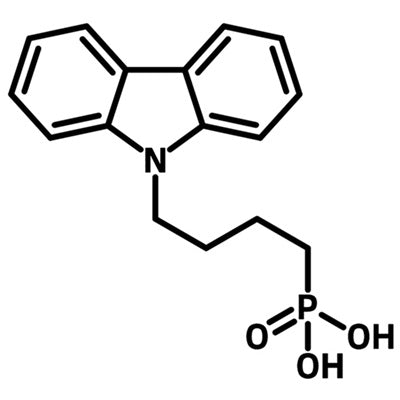
4PACz, or (4-(9H-carbazol-9-yl)butyl)phosphonic acid (CAS 20999-36-4), is a small molecule that forms a self-assembled monolayer (SAM) acting as a hole transport or hole extraction layer. It is used in p-i-n perovskite solar cells and in organic solar cells based on non-fullerene acceptor (NFA) polymers.
The molecule combines three parts: a phosphonic acid group that bonds chemically to the electrode, a carbazole end group that touches the active layer, and an n-butyl spacer linking the two. This spacer is longer than the one in 2PACz, giving extra stabilising van der Waals interactions. Its work function is 4.81 eV, slightly below the 5.1 eV of PEDOT:PSS on ITO.
As a monolayer, PACz materials show lower resistance and higher optical transmittance than PEDOT:PSS, leading to higher short-circuit current density and fill factor. 4PACz can be deposited from solution at low concentration, around 1 mM, typically in anhydrous ethanol, IPA or IPA/DMF. It is supplied as a white powder with purity above 98% (HPLC).
- Hole-selective contact layer in p-i-n perovskite solar cells.
- Hole extraction layer in NFA-polymer organic solar cells.
- Replacement for PEDOT:PSS as a hole transport layer on electrodes such as ITO.
- Research on hole-extracting monolayers for perovskite/silicon tandem solar cells.
| Brand | Ossila |
|---|---|
| CAS number | 20999-36-4 |
| Molecular formula | C16H18NO3P |
| Purity | > 98% (HPLC) |
| Category | — |
| Pack sizes | 500 mg, 1 g, 5 g |
| Physical form | White powder |
| Storage | — |
- Product code: M2452A1
- Molecular Weight: 303.29 g/mol
- HOMO/LUMO: HOMO = 5.52 eV, LUMO = 2.08 eV
- Work Function: 4.81 eV
- Thermal Decomposition: Td = 331 °C (Thermogravimetric analysis)
- Typical Solvents: Anhydrous ethanol, IPA, IPA/DMF
- Typical Concentration: 0.30 - 1.0 mg/ml (1 mM - 1 mg/ml)
—
—