

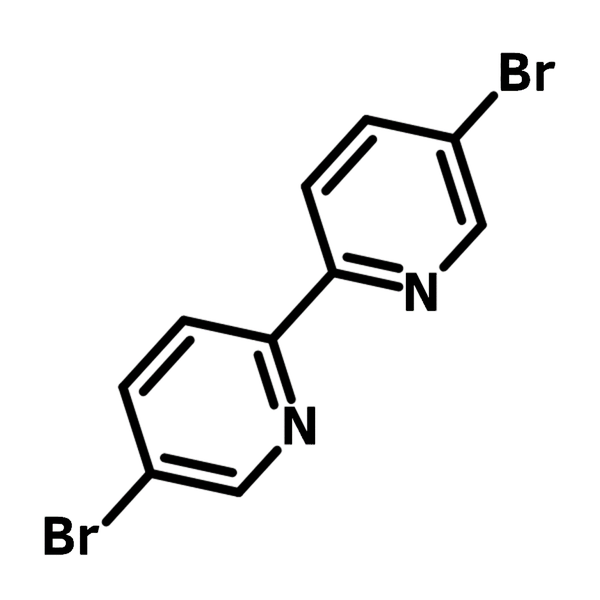
5,5'-Dibromo-2,2'-bipyridine (CAS 15862-18-7) is a bipyridine building block carrying a bromine atom on each pyridine ring. Its main role is as a bidentate chelating ligand for ruthenium (Ru) and iridium (Ir) organometallic complexes. Ru-bipyridine complexes are valued for strong photoluminescence and electrochemiluminescence, which arise from intraligand (π-π*) and metal-ligand charge transfer (MLCT) transitions, making them relevant to OLEDs, dye-sensitized solar cells (DSSCs) and photosensitizers.
The two bromide end groups make the molecule well suited to coupling reactions, so it can be extended into larger conjugated structures. Bipyridine derivatives can be combined with borane species to give organoboron electron acceptors for organic photovoltaics, and ligands with an enlarged chromophore built on this core have been used as photosensors for fluoride ions. Its linear shape also makes it a convenient bridge between functional units when tuning energy band gap and intramolecular spacing.
Ossila supplies this compound as an off-white powder with >98% purity (1H NMR) and a melting point of 226 - 227 °C, in 1 g, 5 g and 10 g packs.
- Chelating ligand for synthesizing ruthenium and iridium organometallic complexes.
- Building block for emissive materials in OLED research.
- Ligand precursor for ruthenium dyes in dye-sensitized solar cells.
- Intermediate for organoboron electron acceptors in organic photovoltaics.
- Precursor for extended-chromophore ligands used in fluoride ion sensing.
- Linear bridging unit for adjusting band gap and intramolecular spacing in functional molecules.
| Brand | Ossila |
|---|---|
| CAS number | 15862-18-7 |
| Molecular formula | C10H6Br2N2 |
| Purity | >98% (1H NMR) |
| Category | — |
| Pack sizes | 1 g, 5 g, 10 g |
| Physical form | Off-white powder |
| Storage | — |
- Product code: B1541
- Molecular Weight: 313.98 g/mol
- Synonym: 5-bromo-2-(5-bromopyridin-2-yl)pyridine
- Melting Point: 226 - 227 °C
- Classification: Bipyridine derivatives, Heterocyclic building blocks, Dyes, Semiconductor synthesis intermediates, OLED, OFETs, organic photovoltaics
—
—