

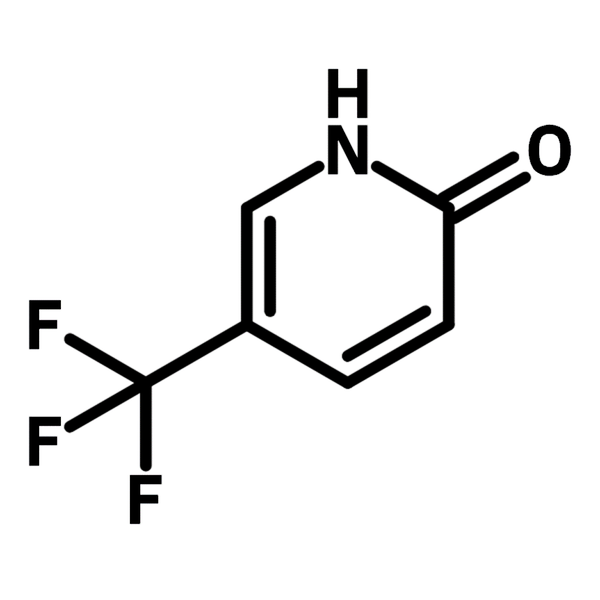
5-(Trifluoromethyl)-2-pyridone (CAS 33252-63-0) is a fluorinated heterocyclic building block supplied as a white powder with >97% purity. It serves as a molecular scaffold in drug discovery and as a ligand in catalytic reactions. Its tautomeric form is 5-(trifluoromethyl)-2-hydroxypyridine, where the hydrogen sits on the oxygen; however, FT-IR measurements of the solid show a C=O stretch with no O-H stretch, meaning the hydrogen lies nearer the nitrogen.
In catalysis, this pyridone is widely applied as a ligand for palladium-catalyzed directed and non-directed sp3/sp2 C-H activation. Through hydrogen bonding it lengthens the C-H bond during the catalytic cycle, giving a six-membered palladacycle intermediate.
For medicinal chemistry, the molecule offers both a hydrogen bond acceptor (ketone) and donor (amine), and acts as a bioisostere for amides, benzenes and pyridines. The trifluoromethyl group raises lipophilicity, which improves cell membrane permeability.
- Ligand for palladium-catalyzed directed and non-directed sp3/sp2 C-H activation reactions.
- Molecular scaffold for drug discovery programmes.
- Bioisosteric replacement for amide, benzene and pyridine groups in drug design.
- Fluorinated building block for general organic synthesis.
| Brand | Ossila |
|---|---|
| CAS number | 33252-63-0 |
| Molecular formula | C6H4F3NO |
| Purity | >97% |
| Category | — |
| Pack sizes | 25 g, 50 g |
| Physical form | White powder |
| Storage | — |
- Product code: B1641
- Full Name: 2-Hydroxy-5-(trifluoromethyl)pyridine
- Synonym: 5-(Trifluoromethyl)-2-pyridinol
- Molecular Weight: 163.10 g/mol
- Melting Point: 145 °C – 149 °C
- Classification: Fluorinated building blocks, Heterocyclic building blocks, Ligands, Catalytic reactions, APIs
—
—