

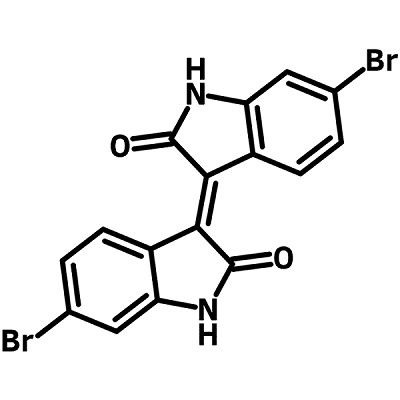
6,6′-Dibromoisoindigo (CAS 1147124-21-7) is an electron-accepting building block used to synthesise molecular and polymeric semiconductors for organic electronics. Supplied by Ossila at >98% purity (by 1H NMR), it appears as a dark red/brown powder or crystals. Isoindigo itself is a naturally occurring isomer of indigo, the historic dye obtained from Isatis tinctoria leaves.
Structurally, the compound consists of two identical fused benzolactam rings linked through a trans double bond. Its strongly electron-deficient core carries useful handles for further chemistry: the N-H positions can be alkylated to improve solubility, while the bromine atoms allow the conjugated system to be extended through coupling.
It is made by condensing 6-bromoindoline-2,3-dione with 6-bromoindolin-2-one in acetic/hydrogen chloride acid, a high-yielding and scalable route that has supported a wide range of isoindigo-based materials. One example, the alternating copolymer PIIG-BT (poly(isoindigo-alt-benzothiadiazole)), has shown electron mobility of up to 0.22 cm2 V-1 s-1.
- Synthesis of low band gap conjugated polymers containing isoindigo acceptor units.
- Preparation of semiconducting materials for organic field-effect transistors (OFETs).
- Development of donor-acceptor polymers for organic photovoltaics.
- Building block for materials explored in OLED research.
- Starting material for N,N′-dialkyl-6,6′-dibromoisoindigo derivatives.
| Brand | Ossila |
|---|---|
| CAS number | 1147124-21-7 |
| Molecular formula | C16H8Br2N2O2 |
| Purity | >98% (by 1H NMR) |
| Category | — |
| Pack sizes | 1 g, 5 g, 10 g |
| Physical form | Dark red/brown powder/crystals |
| Storage | — |
- Product code: B971
- Molecular Weight: 420.05 g/mol
- Synonym: (E)-6,6'-Dibromo-[3,3'-biindolinylidene]-2,2'-dione
- Classification / Family: Isoindigo, semiconductor synthesis intermediates, low band gap polymers, OLED, OFETs, organic photovoltaics
—
—