

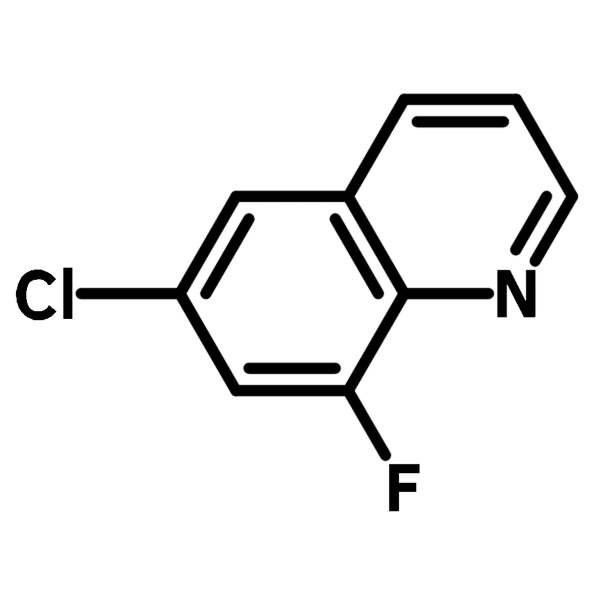
6-Chloro-8-fluoroquinoline (CAS 52200-53-0) is a heterocyclic building block from Ossila based on the quinoline ring, carrying a chlorine atom at the 6-position and a fluorine atom at the 8-position. It is supplied at >98% purity as a white to yellow crystalline solid, with a molecular weight of 181.59 g/mol.
Its best-known role is in pharmaceutical chemistry, where it serves as an intermediate for active pharmaceutical ingredients such as the fluoroquinolone antibiotics Besifloxacin and Clinafloxacin, used in topical antibiotic treatments and for bacterial conjunctival infections.
Beyond drug synthesis, the compound undergoes nucleophilic aromatic substitution to give Schiff bases. These products act as metal-ion recognition sensors, since their fluorescence shifts once they chelate a metal centre. As bidentate or tridentate ligands, they also coordinate readily to Ru and Ir ions, forming dye complexes for dye-sensitized solar cells (DSSCs).
- Intermediate for fluoroquinolone APIs such as Besifloxacin and Clinafloxacin.
- Synthesis of Schiff bases via nucleophilic aromatic substitution.
- Preparation of fluorescent metal-ion recognition sensors.
- Construction of Ru and Ir dye complexes for dye-sensitized solar cells.
- General fluorinated heterocyclic building block for drug discovery and dye research.
| Brand | Ossila |
|---|---|
| CAS number | 52200-53-0 |
| Molecular formula | C9H5ClFN |
| Purity | >98% |
| Category | — |
| Pack sizes | 1 g, 5 g, 10 g |
| Physical form | White to yellow crystal |
| Storage | — |
- Product code: B1881
- Molecular Weight: 181.59 g/mol
- Melting Point: 79 °C – 81 °C
- Classification / Family: Fluorinated building block, Heterocyclic building block, Quinoline derivatives, Schiff base, Dyes, Semiconductor synthesis intermediates, organic photovoltaics
—
—