

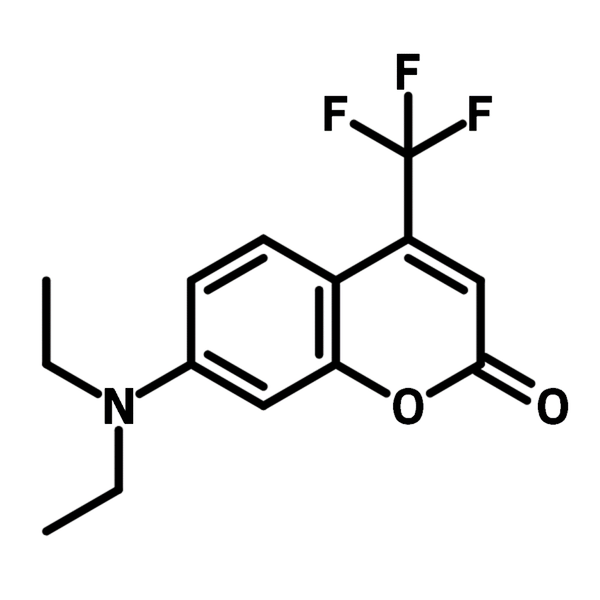
7-(Diethylamino)-4-(trifluoromethyl)coumarin, also known as Coumarin 481 (CAS 41934-47-8), is a fluorinated heterocyclic building block used as an intermediate in the synthesis of dyes for dye-sensitized solar cells (DSSCs), OLEDs and bioimaging. The coumarin core carries a diethylamine group at the 7-position and a trifluoromethyl group at the 4-position, giving several functional handles for straightforward synthesis.
Coumarin derivatives of this type are valued as dyes for their strong light conversion, with a reported quantum yield of 94.8%, which makes the compound an attractive candidate for OLED and DSSC research. Treatment with Lawesson's reagent converts it to the corresponding thiocoumarin, opening the way to further functionalization that shifts the absorption and emission spectra.
Emission of these coumarin derivatives spans 380 nm to 550 nm, a range well suited to bioimaging work. The material is supplied as a pale pink/beige powder with a purity above 97% and is offered in 250 mg and 500 mg packs.
- Synthesis intermediate for dyes used in dye-sensitized solar cells (DSSCs).
- Building block for emissive materials in OLED research.
- Precursor for fluorescent probes in bioimaging, with emission between 380 nm and 550 nm.
- Starting material for thiocoumarin derivatives via Lawesson's reagent.
- Fluorinated heterocyclic building block for drug discovery.
| Brand | Ossila |
|---|---|
| CAS number | 41934-47-8 |
| Molecular formula | C14H14F3NO2 |
| Purity | >97% |
| Category | — |
| Pack sizes | 250 mg, 500 mg |
| Physical form | Pale pink/beige powder |
| Storage | — |
- Product code: B1611
- Molecular Weight: 285.27 g/mol
- Synonyms: Coumarin 481, 7-(Diethylamino)-4-(trifluoromethyl)-2H-chromen-2-one
- Classification / Family: Fluorinated building block, Heterocyclic building block, Dyes, OLEDs, DSSCs, Bioimaging
- Melting Point: 116 °C
- Quantum Yield: 94.8%
- Emission Range (coumarin derivatives): 380 nm to 550 nm
—
—