

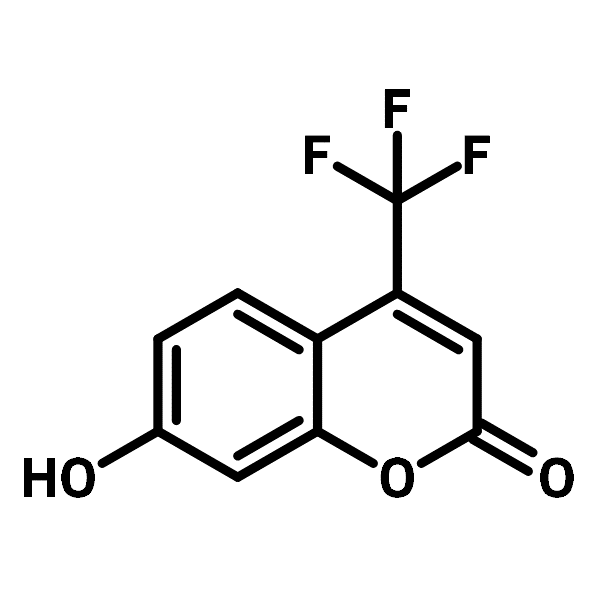
7-Hydroxy-4-(trifluoromethyl)coumarin (CAS 575-03-1) from Ossila is a fluorinated heterocyclic building block based on the coumarin scaffold, a benzene ring fused to a pyrone. It carries a hydroxy group at the 7-position and a trifluoromethyl group at the 4-position, and serves as an intermediate for synthesising dyes used in dye-sensitized solar cells (DSSCs), OLEDs and chemical sensors.
Its delocalised electron core makes the compound useful as a dye and emitter. It binds strongly to H2S/HS−, and its fluorescence grows stronger once bound, so it can act as a sensor for these species. Its photoresponse also depends on the microviscosity and polarity of its surroundings, which allows it to track reactions such as polymerization. Theoretical work further points to possible proton transfer or proton shuttling in the excited state, linked to changes in photoacidity.
The material is supplied as a pale purple powder with a purity above 98% and a melting point of 178 °C – 180 °C, in 1 g and 5 g packs.
- Synthesis intermediate for dyes and emitters in dye-sensitized solar cells (DSSCs).
- Building block for emissive materials in OLEDs.
- Fluorescent chemical sensing of H2S/HS−.
- Fluorescent probe for monitoring polymerization through changes in medium microviscosity and polarity.
- Fluorinated heterocyclic building block for drug discovery.
| Brand | Ossila |
|---|---|
| CAS number | 575-03-1 |
| Molecular formula | C10H5F3O3 |
| Purity | >98% |
| Category | — |
| Pack sizes | 1 g, 5 g |
| Physical form | Pale purple powder |
| Storage | — |
- Product code: B1601
- Full Name: 7-Hydroxy-4-trifluoromethylcoumarin
- Molecular Weight: 230.14 g/mol
- Synonyms: 4-(Trifluoromethyl)umbelliferone, 7-Hydroxy-4-(trifluoromethyl)-2H-chromen-2-one
- Classification / Family: Fluorinated building block, Heterocyclic building block, Dyes, DSSCs, OLED, Sensors
- Melting Point: 178 °C – 180 °C
—
—