

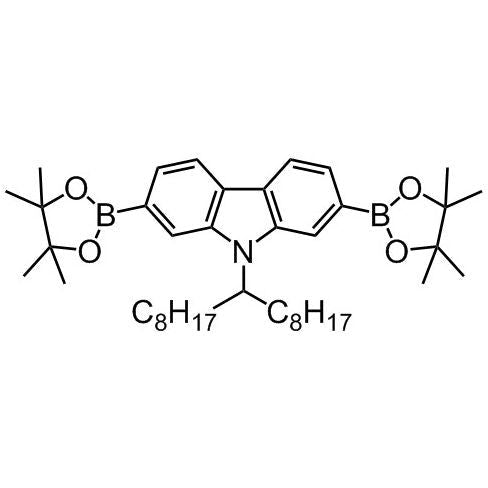
9-(heptadecan-9-yl)-2,7-bis(4,4,5,5-tetramethyl-1,3,2-dioxaborolan-2-yl)-9H-carbazole (CAS 958261-51-3) is a carbazole boronic ester building block. Its two reactive positions are capped with Bpin groups, making it a common intermediate for building small molecules and polymers destined for organic electronic devices such as displays and photovoltaic solar cells.
The compound is made from 2,7-Dibromo-9-(9-heptadecyl)carbazole and is best known as a monomer for the polymer semiconductor PCDTBT. Ossila reports using this material in its own laboratory to synthesise PCDTBT that reached a device performance of 6.7% PCE.
Carbazole derivatives of this kind are widely applied in OFETs, OLEDs and PLEDs. The material is supplied as white crystals with a melting point of 128 °C - 130 °C and a purity of >97%, and its 1H-NMR spectrum in CDCl3 has been recorded for characterisation.
- Synthesis of the low band gap polymer semiconductor PCDTBT.
- Preparation of semiconducting small molecules and polymers for organic photovoltaics and polymer solar cells.
- Building donor materials for organic field-effect transistors (OFETs).
- Development of materials for OLED and PLED display technology.
| Brand | Ossila |
|---|---|
| CAS number | 958261-51-3 |
| Molecular formula | C41H65B2NO4 |
| Purity | >97% |
| Category | — |
| Pack sizes | 1 g, 2 g, 5 g |
| Physical form | White crystals |
| Storage | — |
- Product code: B131
- Molecular Weight: 657.58 g/mol
- Melting Point: 128 °C - 130 °C
- Density: 1.01 g/cm3
- Synonym: 9-(1-Octylnonyl)carbazole-2,7-bis(boronic acid pinacol ester)
—
—