

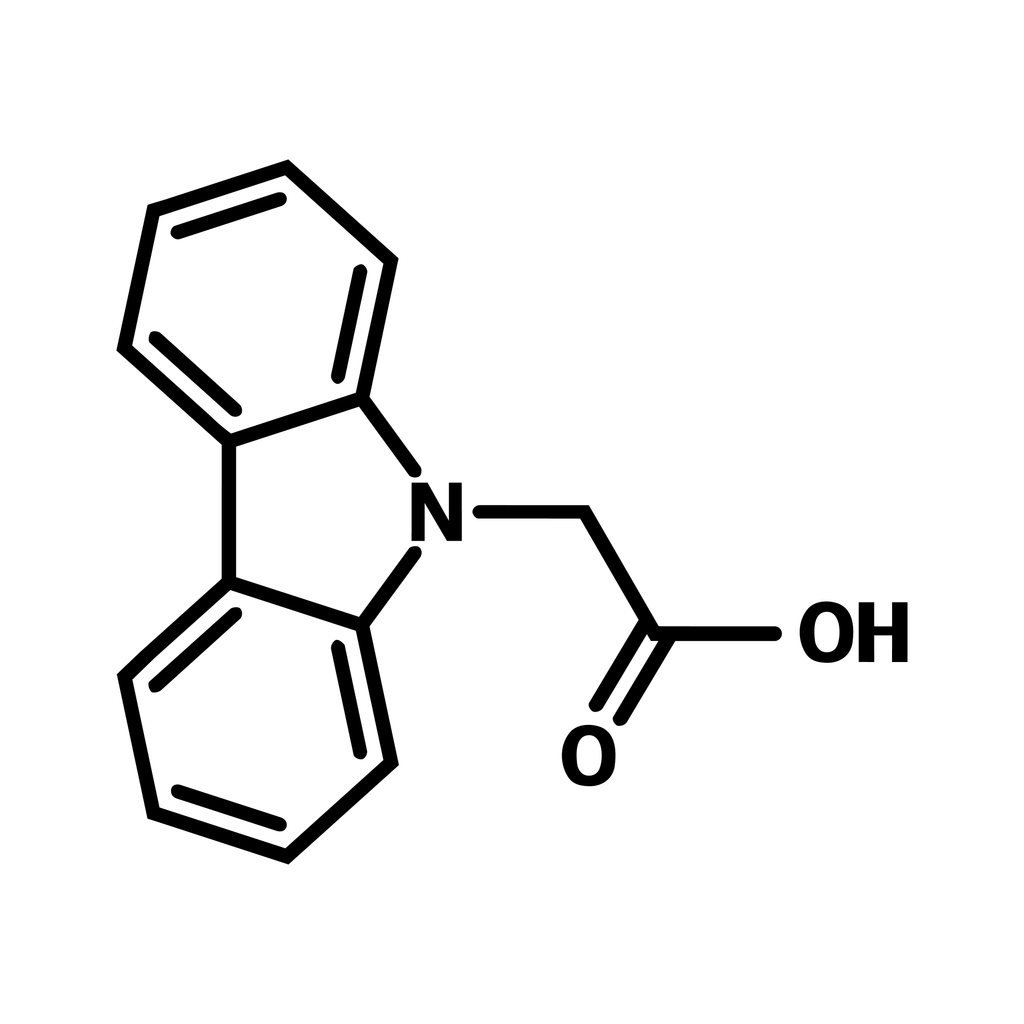
9CAA, or 2-(9H-Carbazol-9-yl)acetic acid (CAS 524-80-1), is a small self-assembled monolayer (SAM) molecule used as a hole transport or hole extraction layer in p-i-n perovskite solar cells and non-fullerene acceptor (NFA) polymer solar cells. Its structure combines a carboxylic acid anchor that binds to the electrode, a short methylene (-CH2-) spacer and a carbazole terminal group.
Carboxylic acid anchors are a widely used alternative to phosphonic acids, particularly in tin-lead (Sn-Pb) perovskite devices. Compared with phosphate-anchored layers, the carboxylate-anchored monolayer interacts more strongly at the interface and adopts a more favourable orientation and packing. Using 9CAA as the contact also reduces nonradiative recombination and improves crystallinity of the perovskite layer. Reported Sn-Pb devices with a ~1.25 eV bandgap absorber reached efficiencies up to 23.1% and open-circuit voltages up to 0.89 V, keeping 93% of initial efficiency after more than 2500 h of unencapsulated storage under N2.
9CAA offers a solution-processable alternative to PEDOT:PSS, deposited from low-concentration solutions around 1 mM. It is supplied as a white powder or crystals with purity above 98% (HPLC).
- Hole selective contact in p-i-n perovskite solar cells.
- Self-assembled monolayer interface for narrow-bandgap tin-lead perovskite solar cells.
- Hole transport or extraction layer in NFA-polymer organic solar cells.
- Solution-processed replacement for PEDOT:PSS in photovoltaic device research.
| Brand | Ossila |
|---|---|
| CAS number | 524-80-1 |
| Molecular formula | C14H11NO2 |
| Purity | > 98% (HPLC) |
| Category | — |
| Pack sizes | 500 mg, 1 g, 5 g |
| Physical form | White powder/crystals |
| Storage | — |
- Product code: M2461A1
- Molecular Weight: 225.24 g/mol
- HOMO/LUMO: 5.35 eV (WF FTO)
- Melting Point: 191-194 °C
- Synonyms: Carbazol-9-yl-acetic acid, 2-(9H-Carbazol-9-yl)acetic acid, CzAA
- Typical Solvents: Ethanol, methanol, IPA, DMF, THF
- Typical Concentration: 1 mM - 1.0 mg/ml
—
—